
A collection of our most recent blog posts to help you navigate our portal


On the 23rd of February 2023, Innovate Durban hosted a FireSide Chat with our guest speaker Rachael Z. Miller where we discussed innovative solutions to avoid water and ocean pollution. This was a major eye-opener to how humans have impacted our environment on a large scale. Through the wasteful nature of people, the environment has suffered in many ways. This article will focus on the emission of micro-plastics into our oceans.
The Rozalia Project
This project is based in Burlington, Vermont, and the Gulf of Maine where it focuses on the protection and cleaning of the ocean using technology, innovation, solutions-based research, and engaging STEM programmes. Their mission is to clean and protect our oceans. The Rozalia Project has been working on the problem of marine debris since 2010. Their work covers the surface to seafloor, with a focus on urban and coastal waterways, and utilise multiple strategies: prevention through education, remediation (cleanup), innovation, and solutions-based research. The project made the discovery that most of the trash is generated in urban areas, inland, and coastal areas.
What are Microplastics?
These are small pieces of plastic that are a result of the breakdown of larger plastic items, such as water bottles, bags, and packaging materials, which can take centuries to decompose in the environment.
Microplastics are intentionally produced through the manufacturing of ordinary cosmetic products like facial scrubs and toothpaste. These products often contain small plastic beads or microbeads, which are washed down the drain and enter waterways. Once having entered the environment, microplastics can cause harm to marine and wildlife by being ingested or entangling animals. They can also contaminate the food chain as they are consumed by small aquatic organisms, which are then eaten by larger animals.
There are 2 types:
How this affects us
The problem is closer to us than we think. Our household washing machines cause our clothes to break into tiny pieces (microfibers) each time it is washed. This means that there are 700 000 pieces per garment per wash. This contributes to microfiber pollution since this graywater is often disposed of into larger bodies of water. This harms nature in a physical aspect such as abrasions in the throats of sea creatures and starvation in much marine life. The chemical aspect is much more detrimental and results in heavy metals, chlorobenzenes, and many more that run off into our waterways.
The Solution
The co-founder of the Rozalia Project, Rachael Z. Miller introduced us to her brilliant innovation, The Cora Ball.
The Cora Ball was inspired by coral filters in the ocean. This ball is a kind of laundry ball that prevents micro fibers from breaking off our clothing and collects these fibers into a type of fuzz so they can be disposed of in the right manner.
The Cora Ball has been produced through 3D printing and is made from plastic. It has a lifespan of 6 years. It is known to have an efficiency of 31% and can reduce shedding.
1. Forensics Team
Microfibers have long been a crucial component of forensic research. Conventional procedures are used in forensic investigations to reduce potential contamination and identify fibers that came from the same source. Due to the nature of forensic examinations, their design must prioritise the objectivity and validity of the methodology. Investigations of marine microfibers face many of the same difficulties as forensic investigations, therefore their identification may benefit from the adaptation and application of well-established forensic procedures. Researchers in Australia are using forensic techniques to study the sources and transport of microplastics in the marine environment, including the use of particle tracking technology to follow the movement of plastic particles. The Norwegian Institute of Marine Research is using forensics to identify the sources and distribution of microplastics in Norwegian waters, as well as the potential impacts on marine life.
2. Stop Balloons
Balloons can contribute to microplastics in a few different ways such as when balloons are released into the environment and they eventually break down and release small plastic particles known as microplastics. Balloons can also pose a threat to wildlife. Animals may mistake the balloons for food, and when they ingest the balloons, the balloons can break down into microplastics in their digestive systems. There are some places where balloon releases are already banned, such as in some US states and countries like Australia and Costa Rica. Some cities and towns have also implemented bans on certain types of balloons, such as those made of non-biodegradable materials like Mylar.
3. Marine Debris art in Korea
This art is created using marine debris such as plastic waste and other materials found on beaches and in oceans. In Korea, there are several artists and organisations that are using this form of art to raise awareness about the issue of marine pollution and to promote environmental conservation. The Korea Marine Environment Art Network (KMEAN) is a group of artists and activists who use marine debris as their medium to create art installations and sculptures. Their works are often displayed in public spaces and at events, and are intended to raise awareness about the impact of marine pollution on the environment and marine life. Marine debris art is gaining popularity in Korea as a means of promoting environmental awareness and encouraging people to take action to reduce plastic waste and other forms of marine pollution.
4. Regulations and Policies
There are a number of regulations and policies that have been put in place around the world to address the issue of microplastics. The United States, Canada, the United Kingdom, and France have banned the use of microbeads in personal care products such as facial scrubs and toothpaste. Many countries and cities have implemented bans or fees on single-use plastic bags, which can break down into microplastics over time. For example, in 2021, the European Union implemented a ban on single-use plastic products, including plastic bags. The Netherlands has a programme in place to treat wastewater and capture microplastics. Canada has implemented extended producer responsibility programmes that require companies to take responsibility for the entire lifecycle of their products, including the waste generated by those products. Many countries are also implementing educational campaigns and awareness programmes to educate the public about the issue of microplastics and encourage individuals to take action to reduce plastic waste. These are just a few examples of the regulations and policies in place around the world to address the issue of microplastics. The Save Our Seas Act (SOSA) is a U.S. federal law that was first introduced in 2017 and reauthorized in 2018 and 2020. The act was designed to address the problem of marine debris and ocean pollution, including plastic pollution.
5. Plastic Bank
This is an international organisation that aims to reduce plastic waste and poverty by creating a market for recycled plastic. The organization has set up several “plastic banks” in Haiti to encourage people to collect plastic waste and exchange it for goods or cash. Plastic Bank has provided a source of income for thousands of Haitians while also reducing the amount of plastic waste that ends up in the environment. In addition to its work in Haiti, Plastic Bank has set up similar programmes in several other countries, including Indonesia, the Philippines, and Brazil. Through these initiatives, the organisation is working to create a more sustainable future by reducing plastic waste and promoting social and economic development.
6. Bubble Barrier
A bubble barrier is a system that uses air bubbles to trap plastic waste and other debris in waterways, preventing it from flowing downstream. The system works by creating a wall of bubbles across a river or canal, which creates a barrier that traps floating debris and directs it to a collection point. The Netherlands is one of several countries that has implemented bubble barrier systems to address the problem of plastic waste in its waterways. The Bubble Barrier in Amsterdam consists of a tube that is placed on the bottom of the canal, which releases a stream of bubbles that rises to the surface. The bubbles create a barrier that pushes plastic waste and other debris to the sides of the canal, where it can be collected and removed.
These are just a few of the innovative ways in which countries have tried to solve the microplastic pollution problem.
I will end this piece with a wise quote: “The oceans are the planet’s last great living wilderness, man’s only remaining frontier on Earth, and perhaps his last chance to prove himself a rational species.” – John L. Culleny. As humans, we need to do better at conserving our planet.
For more information on this topic follow http://instagram.com/rozaliaproject and https://www.instagram.com/innovatedurban/ .
By: Tamisha Gengayah

By Andre Pillay
In today’s rapidly changing world, innovation is key to progress and success, but with numerous challenges facing economies, cultivating a culture of innovation is more important than ever. That’s where ChatGPT comes in. Developed by OpenAI, ChatGPT is an advanced artificial intelligence-powered language model that can inspire, teach, and cultivate innovation.
ChatGPT’s ability to understand and generate human-like responses to a wide range of questions and commands makes it a valuable tool for inspiring innovation. Individuals can explore new concepts and learn from the perspectives of others by engaging in conversations with ChatGPT. This can help generate new and innovative ideas and provide inspiration for thinking outside the box and approaching challenges in new ways.
Furthermore, ChatGPT can also be used to teach innovation by providing information and resources on entrepreneurship. It can help people develop the skills and knowledge they need to bring their ideas to life, including how to turn an idea into a business plan, find funding, and network and collaborate with like-minded individuals.
Cultivating a culture of innovation is also critical to progress and growth. ChatGPT can play a role in this by fostering conversations and providing information on innovation. By spreading awareness about the importance of innovation, ChatGPT can encourage people to embrace new ideas and technologies, creating an environment where innovation is valued and supported.
In addition to its potential impact on innovation, ChatGPT can also revolutionize the workplace. It has numerous applications that can enhance work processes and efficiency.
For example, ChatGPT can improve customer service by automating repetitive tasks such as answering frequently asked questions and directing customers to relevant resources. This can free up time for human customer service representatives to focus on more complex and challenging customer inquiries, leading to higher customer satisfaction and loyalty.
ChatGPT can also automate routine and time-consuming tasks in the workplace, such as data entry, scheduling appointments, and generating reports. This can free up employees to focus on more important and value-adding activities, enhancing productivity.
Furthermore, ChatGPT can improve collaboration and communication within the workplace. Providing quick and accurate answers to questions can save time and minimize misunderstandings, resulting in more productive and efficient teams. It can also be integrated into team chat apps to assist employees in real-time,but that’s not all.
ChatGPT can also be a valuable tool for innovators in the innovation ecosystem. Its ability to generate ideas, facilitate learning and collaboration, and support decision-making can contribute to the growth and success of innovation projects and initiatives.
Like anything, there will always be bad with the good so here are some possible cons of using ChatGPT:
Job Loss: AI has the potential to replace jobs currently done by humans, leading to a loss of jobs in industries that rely on human labor. While some new jobs may be created, thenet effect could be negative.
Dependence: People may become too reliant on AI for decision-making, which could lead to a decrease in critical thinking and problem-solving skills and a lack of diversity in opinions and perspectives.
Privacy: AI systems rely on large amounts of data, which can raise concerns about privacy and security. Companies must ensure that they are collecting and using data ethically and transparently, which can be a challenge in an age where data breaches are becoming more common.
Bias: AI systems can be biased due to the data used to train them or the algorithms themselves. This can lead to discriminatory outcomes in hiring or lending decisions.
Cost: Implementing AI can be expensive, especially for smaller companies. The cost of developing and maintaining AI systems may be prohibitive for some businesses, leading to further consolidation in industries dominated by larger companies.
It’s clear that this technology has both positive and negative implications for society. While AI has the potential to revolutionize industries and improve the quality of life for individuals, it also poses several concerns that must be addressed.
However, it’s important to note that the success of AI implementation depends largely on how it’s utilized. Companies and individuals must take steps to ensure that AI is being used ethically and transparently, and that potential negative consequences are being mitigated. By taking a responsible approach to AI, it’s possible to harness its benefits while minimizing its drawbacks.
Therefore, it’s crucial for businesses and individuals to be mindful of the potential risks associated with AI, and to use it in a responsible and ethical manner. Ultimately, the success of AI implementation will depend on the choices we make about how we use it. With careful consideration and responsible action, we can ensure that AI is a positive force for change in society.
References:
Dickson, B. 2022. What to (not) expect from OpenAI’s ChatGPT. TechTalks. Available: https://bdtechtalks.com/2022/12/05/openai-chatgpt/.
Zinkula, J. Mok, A. 2023. 7 Ways to Use ChatGPT at Work to Boost Your Productivity, Make Your Job Easier, and Save a Ton of Time. Entrepreneur. Available: https://www.entrepreneur.com/business-news/how-to-use-chatgpt-to-save-time-and-make-work-easier/444622.

By: Tamisha Gengayah
The increasing digitalisation of society has led to various aspects of everyday life relying heavily on the digital sphere. This has resulted in the generation of vast amounts of data, known as big data, through the digital traces and footprints left behind by individuals. With the aid of advanced analytic tools like AI, valuable information can be extracted from this massive pool of data, enabling significant advancements in various fields.
The term ‘big data’ refers to large, complicated data that are challenging to manage using conventional data processing methods. Big data is described using the “3 Vs”—volume (big amount of data), velocity (rapid rate of data in and out), and variety (wide range of data types and sources). Big data analysis can spot trends, patterns, and insights that traditional approaches can overlook. This ability to collect and analyse vast amounts of data is a key component of the Fourth Industrial Revolution (4IR).
Big data has made significant advancements in many areas, including healthcare, reducing crime by analysing patterns and trends, protecting the environment by tracking, and analysing environmental changes, disaster relief, and many more areas. Here lies the problem. Some would argue that there must be a drawback to big data if it can collect enormous volumes of data and handle it without error. Big data’s ethics and privacy policies have frequently come under scrutiny.
Privacy Concerns
Many people have questioned who is responsible for ensuring that big data is collected, stored, and used ethically, and who is accountable for any harm that results from its misuse. Some people question the ownership of the data that is collected and how is it being used and shared.
There are many laws and policies in place to protect sensitive information, however, these laws are sometimes overlooked by large corporations. The most recent case involving Microsoft’s illegal collection and retention of children’s data for its Xbox video game console raised significant concerns about big data and privacy issues. Microsoft had collected data from children without parental consent and retained it unlawfully, clearly violating the Children’s Online Privacy Protection Act (COPPA). This incident highlighted the need for stricter regulations and safeguards to protect the personal information of users, especially children.
This situation raised public awareness of the potential dangers of big data in the context of children’s privacy. With the mass creation of digital technologies, including gaming consoles, social media platforms, and online services, vast amounts of data are being generated, collected, and analyses daily. Companies like Microsoft have access to extensive personal information and even sensitive details like health and behavioral patterns. In cases where children are involved, it is crucial to protect their privacy since they may not fully understand the implications of sharing their personal information, making it essential for parents/guardians to be involved in consent processes.
This case is a reminder that big data concerns extend beyond individual privacy. They raise broad questions regarding the responsible handling and disposal of data. It emphasises the need for effective data protection regulations, strict enforcement, and corporate accountability to ensure the safeguarding of personal information in the digital age.
A Solution to the problem
To solve this and put people at ease, it is important to ensure transparency in the collection, storage, and use of big data so that individuals are aware of how their information is being used and can make informed decisions about it. People should also be granted access to and control over their data, including the right to know what data is being collected and how it is used. Since companies and originations that are collecting big data often collect sensitive information about individuals, such as their financial history, health records, and personal preferences.
Here are a few steps users can take to protect themselves from big data concerns:
Be mindful of what information you share online. Only share personal information on trusted websites. Caution is advised when sharing sensitive information such as your social security number/ID number, bank account details, and date of birth.
It is advisable to create strong passwords and enable two-factor authentication.
Read privacy policies carefully. Before using a website or app, read its privacy policy carefully to understand how your data will be used, stored, and shared.
Protect your Web browsing by making use of a virtual private network (VPN) which can encrypt your internet connection and protect your online activities from prying eyes.
Use your privacy settings to limit the amount of data you share with websites and social media platforms.
Be wary of phishing scams that are designed to trick you into revealing your personal information.
Be cautious when clicking on links in emails or text messages and never provide personal information to unknown sources.
Install an antivirus software but ensure that it is a legit product. Installing software from sketchy sites can cause more harm.
By taking these steps, you can protect yourself from big data concerns and safeguard your personal information online.
Advantages of Big Data
Despite the privacy and ethical concerns regarding big data, there are many advantages of big data. Big Data has the potential to significantly revolutionise everyday life through improved decision-making since big data enables organisations to analyse vast amounts of information, leading to more informed and accurate decisions.
Big data has the potential to increase efficiency by allowing organisations to identify inefficiencies and optimise processes, leading to increased productivity and cost savings.
Another underrated benefit of big data is Innovation. The development of new products and services is all possible through analysing trends in large amounts of data. Big data can provide companies with new insights and opportunities for innovation, leading to the development of new products and services.
In conclusion, the emergence of big data in our increasingly digital society has brought both opportunities and challenges. While big data analysis has shown great potential for advancements in various fields, it has also raised significant ethical concerns regarding privacy.
Instances like the Microsoft case have highlighted the need for stricter regulations and safeguards to protect personal information. It is essential to ensure transparency in the collection, storage, and use of big data, granting individuals access and control over their data. Strengthening data protection regulations and corporate accountability are vital steps in safeguarding personal information in the digital age. Individuals can also take measures to protect themselves from big data concerns, such as being cautious when sharing information online, using strong passwords and utilising privacy settings to limit data sharing.
Despite the challenges, big data analysis offers significant advantages, including improved decision-making, increased efficiency, and opportunities for innovation. By addressing ethical considerations, we can harness its potential while ensuring the protection of privacy.
References:
Big Data Analytics – Ethical And Privacy Issues. n.d. Eaton Business School. Available: https://ebsedu.org/blog/data-analytics-ethical-privacy-issues/.
Duggal, N. 2023. Top 7 Benefits of Big Data and Analytics and Reasons to Consider It. Available: https://www.simplilearn.com/benefits-of-big-data-and-analytics-article.
Klosowski, T. n.d. How to Protect Your Digital Privacy. The New York Times. Available: https://www.nytimes.com/guides/privacy-project/how-to-protect-your-digital-privacy.
The Big Data Debate: Big Risks vs Big Opportunities. n.d. Cicero. Available: https://cicerogroup.com/blog/2019/07/17/the-big-data-debate-big-risks-vs-big-opportunities/.
The Washington Post. 2023. Microsoft will pay $20M to settle U.S. charges of illegally collecting children’s data. Available: https://www.washingtonpost.com/business/2023/06/05/microsoft-xbox-childrens-data-ftc-fine/54419e80-040c-11ee-b74a-5bdd335d4fa2_story.html#.
Weinhardt, M. 2021. Big Data: Some Ethical Concerns for the Social Sciences. Social Sciences 10: 36.

By: Jason Strauss
In the dynamic realm of design, we navigate a competitive journey filled with both triumphs and tribulations, where each moment is an opportunity for continuous growth. As 3D designers, our passion fuels our drive to create exceptional work, but the burning question often remains: How can we ensure that our creative endeavours not only resonate with our own aspirations but also align seamlessly with the expectations of our valued clients and customers?
In this article, we’ll delve into the best practices for managing the high expectations of our clients, which is a critical aspect of our craft. We’ll explore the transformative power of collaborative work, unlocking its potential to elevate the value 3D designers can bring to our client’s projects. Moreover, we’ll address the enduring concern surrounding artificial intelligence’s (AI) role in design, dispelling common worries and highlighting its potential to revolutionise our creative processes. So, let’s embark on this journey together, embracing the challenges and opportunities that lie ahead in the ever-evolving world of design.
Navigating Client Expectations: The Role of a 3D Designer
Clients are a strange kind of people; they know exactly what they want, but they don’t know how to make it possible. We see this when we start a new project with a client, and 3D designers always begin with the initial conversation:
As a 3D designer, our role is to transform their vision into reality. After all, if clients could have done it themselves, they would have. Designers have developed an intuition about these sorts of things, which we have earned over time through experience. You will frequently be reminded that your clients often do not have this intuition or a clear understanding of what’s possible. This often materialises as the inevitable frustration that clients often dream big and dream expensive! That’s not their fault, and they don’t know what the parameters of possibility are. It is then on you, the 3D designer, to take a moment right at the beginning to explain what would be possible or not; clients need to clearly understand what it costs and how long it will take.
And no, they won’t run away.
The biggest fear that comes from saying, “I’m sorry, but I can’t do that,” is that we might lose our client. If we can’t do it the way they want or for the price they need, then it is better to part ways with that client. Our intentions are not to be big and scary, but to mould their idea into a possible space that you can work within.
A trick is to suggest alternatives and have a conversation about new creative ideas; it is a creative process after all.
Instead of:
“I can’t do that.”
“That will be R40 000.00”
“That won’t work.”
Rather use:
“How do you feel if we make it shorter?”
“I could do it in pieces but that would take longer.”
“If we just did this for now, it could fit into your budget.”
As a 3D designer, you can prune this creative tree, but if you prune it with a chainsaw, you will kill it, so prune honestly and delicately.
Get clients involved
The design industry is great, and your customers know that. Clients proudly showcase their furniture, product, painting, or part that you designed, remembering not only what it is to them now but also what it took to get there. More often than not, a client who is onboard and involved with the design and development journey will keep the nostalgia of the process at heart as they proudly showcase the product that you designed, as they are equally, if not more, invested than you in their design coming to life. This iterative process is very important for clients. Designers need to remember that clients are there for this collaborative journey.
As an experienced 3D designer, I’ve found that my clients are happiest when they feel like they have contributed to the design process. Most of the time, the client takes as much ownership as you can give them when it comes to their participation in the design. I haven’t figured out how to get them to do all the work yet, but research continues!
I have moved my design workflows onto platforms that allow for the seamless sharing of content and tools that allow me to instantly share a 3D file that can be explored on a web app without any sign-ups or special programmes. Platforms like Fusion 360 or Onshape allow for this kind of seamless sharing that grants your clients the ability to watch design happen live with the ability to comment on parts, features, and materials on the go. Overall, this streamlines the design process as designers receive assistance and feedback from customers. You will find a more satisfied client at the end of the design journey if they were included along the way.
Artificial intelligence
Yes, you knew this was going to come up.
It won’t steal your job, just like pliers won’t take away work from a mechanic and bricks won’t take away work from an architect. AI does this scary thing where it can make amazing work using the classic vague requests that customers provide; furthermore, the work is done in seconds compared to weeks, but it still doesn’t replace the designer.
As mentioned before, our role is to transform the client’s ideas into reality, and what we have now are tools to make that easier. Your client may now clearly provide an on-the-shelf concept art of the product idea that they need, but you are still critically needed to reach that final dream, and there is now less communication needed.
Some of us in the design space believe that models like DALL-E have replaced us, but the nature of our modern AI tools lacks the nuances that are developed from your experience and skill. We can consider AI art as a Version 1 or a starting point if we want to achieve better human-centred design. AI has the potential to improve the efficiency of the design process, as designers may not be required for low-quality, less arduous work – but can rather focus on other tasks. Some examples of DALL-E prompts that I am glad not to have dealt with are:
The advice when it comes to trained models and AI tools is to embrace them, know their shortcomings, such as their inability to consider the end application of the design which often results in designs that exceed manufacturing limits and tolerances, and consider them a platform that you can work from instead of a tool to be wary of and shy away from. I have limited drawing abilities, and sometimes struggle to understand the visual ideas my clients have, so I often resort to using AI tools to help the customer explain to me what they envision. This helps tremendously and normally saves me time by avoiding 2 or 3 product refinement meetings that can occur when there isn’t a clear agreed-upon direction.
In the realm of 3D design, the synergy between designer and client is a dynamic journey of collaboration and creativity. Clients, though filled with vision, often need guidance to translate their ideas into reality. Instead of dismissing their desires, we should delicately prune and suggest alternatives, nurturing a shared creative process. Engaging clients in the design journey fosters satisfaction and connection, while the rise of AI tools should be seen as a complement rather than a threat, enhancing our capabilities. As we adapt and innovate, designers bridge the gap between creativity and client expectations, forging a future where possibilities are boundless and design is a harmonious partnership.

By: Tamisha Gengayah
Female entrepreneurship is often under-researched, particularly in the African context. Most of the available literature is written by non-Africans in the context of the developed world. Despite the paucity of literature, female entrepreneurship is a critical element shaping a region’s socio-economic development. Often, women have been excluded from meaningfully participating in the economy because of traditions, religious beliefs, and cultural practices (Boateng, 2017). This article reflects on an interesting discussion that I had with female entrepreneurs at Innovate Durban’s American Corner, and a subsequent review of related literature. This discussion brought to light the universality of experiences, despite the diversity of backgrounds. This article highlights some of the key themes that emerged during this discussion, with the hope that readers may find resonance and insights to navigate their own challenges.
What initiated the discussion?
On the 4th of December 2023, Innovate Durban’s recently established American Corner hosted a film screening of She Did That, showcasing the inspirational work of the talented Renae L. Bluitt. Renae is a New York-based filmmaker who has brought to life the stories and struggles of Black women entrepreneurs by addressing pressing issues such as the funding gap for women of colour, and their trials and wins as they attempt to break the barriers that confine them. The documentary focuses on the story of four remarkable black female entrepreneurs: Luvvie Ajayi, an author, speaker, and digital strategist; Lisa Price, the founder of Carol’s Daughter, a hair care brand; Melissa Butler, the creator of beauty brand The Lip Bar; and Tonya Rapley, a financial expert from My Fab Finance. This film was created to shed light on the authentic challenges and experiences faced by Black women entrepreneurs, going beyond their appearances on social media. The film draws back the curtain, providing insight into the how and why of their journeys. This film opened my mind to the plight of women, more specifically women of colour, in their entrepreneurial journeys.
Following the screening, I facilitated a discussion with 10 young and hard-working women who, despite their circumstances, are nothing short of inspirational. These ladies come from different walks of life and have overcome many obstacles in their educational, entrepreneurial and self-growth journeys. Collectively, the group reflected on the film screening and their diverse experiences as female entrepreneurs. Organically, the discussion with the attendees focused on the real-life challenges female entrepreneurs face, and several themes related to entrepreneurship and female entrepreneurship emerged.
Acknowledging mental health challenges
A major theme that emerged from the discussion was centred on mental health concerns, in particular, the depression and loneliness that come with not having a good support system and people that you can fall back on. Often, the group of female entrepreneurs felt that it was taboo to vent to a parent because certain ethnicities might view this as disrespectful because of the way they were raised or even ignorance towards mental health. Without a solid support structure to fall back on, they can often feel isolated and burnt out, which is very taxing on an individual. Some of the attendees noted that they would seek therapy as a means of dealing with their depression, too often uncovering childhood wounds. While therapy may seem like the ideal solution to some, the discussion highlighted the stigma associated with therapy or people not being fortunate enough to access these types of resources. In these cases, some attendees reflected that they would take a few days to wind down and relax in solitude, where they could gather their thoughts and anticipate their next moves. Others enjoyed listening to podcasts to distract themselves: a suggested podcast is Wisdom & Wellness with Mpoomy Ledwaba. Some, who were fortunate enough, could rely on their parents, friends and partners to support them when they could not give 100% to different aspects of their lives.
In the weeks after the discussion, I explored literature related to entrepreneurship and mental health challenges. Blum and Miller (2021) suggested a few ways to improve mental health. One of the most important aspects is giving your feelings a name. Often, we struggle to articulate what we are actually feeling; we aren’t burnt out or depressed, but something in between or not quite to this magnitude. This feeling is called languishing and is often called the neglected middle child (Blum and Miller, 2021). Another way to manage your mental health is to find meaning in your everyday activities. This can be done by completing your activities, even things you dread, with more purpose and tenacity. Remember that if you don’t prioritise your mental health, you will be pouring from an empty cup.
Identifying your support system
The second theme that emerged from the discussion was the importance of identifying your support system. Now, you might think that it is a given that you would receive emotional support from those closest to you, but often, this is not the case. Most of the discussants had experiences where their friends were not fully in their corner, where multiple participants held the perception that their friends were not supporting their businesses and entrepreneurial endeavours. However, several women noted that some of their greatest supporters were strangers or people they were not close to. This takes me back to an old quote by Heath Ledger: “Your BIGGEST supporter is a stranger, and your BIGGEST hater is someone you know well”.
This perception held by the attendees is somewhat perplexing, but there are many reasons why they feel the way they do. An article by Whitney (2017), a mindset coach and business strategist, highlighted that as an entrepreneur, you take risks and step into your individual power. For some, other people gaining power relative to themselves is intimidating. People may become accustomed to a version of you that was not confident or bold enough to take this step, so they do not know how to react to this new powerful and confident version of you. A possible underlying reason for this is that they might feel that on your journey to entrepreneurial success, you might change and view them differently (Whitney, 2017). Most people are comfortable doing what they know and sticking to their routine because it gives them a sense of safety, comfort and security, so it is somewhat perplexing to them when someone is willing to take risks and step out of these norms that they are accustomed to. In contrast, strangers who become acquaintances and transition into friends along the entrepreneurial journey often have less bias towards you since they only know this ‘new’ version of you and can also relate to your challenges. It is helpful to remind yourself that you are not responsible for, nor can you control, the way that friends and family act towards you. However, you are responsible for how you choose to react to this.
Imposter syndrome
Aligned with the theme of mental health, many of the ladies brought up the feeling of imposter syndrome – the third theme. A captivating article by Martins (2023) describes imposter syndrome as a feeling of self-doubt when it comes to your accomplishments. With this syndrome, people feel like they do not deserve certain things or opportunities because they do not feel good enough or that they have tricked people into thinking that they are good at something. Imposter syndrome is very prevalent in the workplace. It can often manifest as a lack of confidence in your work, getting upset over minor mistakes, burnout and even a fear of disappointing your team.
Silva (2020) highlighted that as an entrepreneur, you are constantly pushing yourself and getting your foot into doors you have never been in before; this will often result in imposter syndrome. How do you know once you have succeeded or reached ‘expert’ status? Is there even such a thing as ‘expert’ status? This is more of something that comes with time, experience and knowledge. It is good to remind yourself that you do not know everything. However, this should not stop you from sharing the knowledge that you possess or building a business around this knowledge.
There are several ways to overcome imposter syndrome, and change your perceptions of yourself:
Queen Bee Syndrome
Queen Bee Syndrome was the fourth theme that emerged from our discussions. Personally, I was surprised that this challenge emerged and how it affects women in professional settings. Queen Bee Syndrome can be summed up as when a woman in a position of power and authority becomes critical and judgmental toward her female colleagues, while also showing special treatment to men, especially in matters like promotions. In contrast to an actual queen bee in her colony, a human queen bee exhibits condescending and hostile behaviour toward other females in a plea to get ahead. Despite the current movement around feminist ideals and the rise of women in leadership roles within traditionally male-dominated fields, this behaviour persists. Surprisingly, some women adopt this behaviour to adapt to male-dominated work cultures, disregarding their female counterparts to climb the corporate ladder (Ramnund-Mansingh, 2020). I recently read an article by Saddleton (2019) which shed light on the magnitude of this behaviour and how deep it runs in professional settings. Queen Bee Syndrome can leave victims devastated, which often leads to reduced productivity in the workplace and on a personal level, as well as limited career advancement.
Here are some suggested ways to avoid the sting of the Queen Bee (Balodi 2013):
Celebrating successes and empowering one another is important
Despite the challenges faced by female entrepreneurs, we need to celebrate successes and empower one another. The discussion revealed that this group of women had fought tooth and nail to achieve their current status. Some entrepreneurs needed two jobs to support their businesses and families, and some were the first in their families to get into a university. These are often conversations we will never hear because of the resilience and tough skin you have to form as a woman, yet alone a female entrepreneur. Women can do great things when they have been included in spaces that previously excluded them, and only by listening to their struggles and accomplishments can we create a more inclusive world for them and future generations.
In an era where a beautiful movement has been deemed as ‘toxic feminism”, we must remember the true essence of feminism and why it was brought about. It is apt to conclude this article with a powerful quote from the youngest female Nobel Prize laureate in history, Malala Yousafzai, “I raise up my voice — not so that I can shout, but so that those without a voice can be heard … we cannot all succeed when half of us are held back.”
References
Balodi, J. (2013). Taking the Sting out of ‘Queen Bees’ Who May Be Out to Get You. Forbes. Available: https://www.forbes.com/sites/johnbaldoni/2013/03/04/taking-the-sting-out-of-queen-bees-who-may-be-out-to-get-you/
Blum, D. and Miller, F. (2021). How to Improve Your Mental Health in 2022: Well’s most popular stories of the year offered tools to stay happy and healthy. The New York Times. Available: https://www.nytimes.com/2021/12/30/well/mind/mental-health-advice-2022.html
Boateng, A. (2017). African Female Entrepreneurship: Merging Profit and Social Motives for the Greater Good. Springer. Available: http://ndl.ethernet.edu.et/bitstream/123456789/38033/1/25.pdf.
Martins, J. (2023). Unmasking imposter syndrome: 15 ways to overcome it at work. Available: https://asana.com/resources/impostor-syndrome.
Ramnund-Mansingh, A. (2020). Queen bees muscle out other women in the workplace. Available: https://www.mancosa.co.za/blog/queen-bees-muscle-out-other-women-in-the-workplace/.
Saddleton, L. (2019). Avoiding the sting of the office “queen bee”. Insurance business. Available: https://www.insurancebusinessmag.com/us/news/diversity-inclusion/avoiding-the-sting-of-the-office-queen-bee-167767.aspx.
Silva, P. (2020). Imposter Syndrome In Your Business And How To Overcome It. Available: https://www.forbes.com/sites/piasilva/2020/05/15/imposter-syndrome-in-your-business-and-how-to-overcome-it/?sh=753375d13048.
Whitney, G. (2017). Top 3 Reasons Why Your Biggest Supporters Will Be Strangers & Not Your Family/Friends. Available: https://www.huffpost.com/entry/top-3-reasons-why-your-biggest-supporters-will-be-strangers_b_57b39619e4b014a587fbb41e.

By: Patrick Martel and Tamisha Gengayah
Academics and practitioners are increasingly focusing on disruptive innovation, which is considered a critical driver behind several successful companies and industries that have changed entire markets. At Innovate Durban, promoting and supporting disruptive innovation is even an organisational priority. But what is disruptive innovation? The following is the first of two articles that explore this concept.
Disruptive innovation, a true game-changer, challenges the status quo and business as usual. It’s when a new product, service, or business model completely transforms an existing market or creates a brand-new one (Christensen, 1997). Initially, a new approach promoted by disruptors may seem somewhat inferior, unconventional or unattractive to mainstream customers (Christensen, 1997). However, with the passing of time, the market becomes redefined, and the leading incumbent players become displaced, showing the power of disruptive innovation to challenge and reshape the business landscape, and promote economic growth. Disruptive innovation may also result in a shift in consumption behaviour.
Professor Clayton Christensen from Harvard Business School coined the term ‘disruptive innovation’ in his 1997 book, The Innovator’s Dilemma. Adopting a longitudinal outlook, Christiansen observed that well-established businesses regularly struggled to adapt to disruptive innovations, as they were too focused on sustaining innovations that cater to their existing customer base and current business models. Christensen (1997) noted that despite many incumbents in the market being well-managed, they overlooked important aspects that triggered their decline. After an in-depth study, Christensen (1997) used a technology-change framework to develop his theory of disruptive innovation.
Christensen’s (1997) seminal work on disruptive innovation examined the disk drive industry, the retail sector and the steel industry. His study revealed that when an innovation emerged that enhanced performance on aspects that mainstream customers typically value, well-established firms tended to lead commercialisation and retained their strong market position (Christensen, 1997; Christensen et al., 2018). However, when an innovation was developed and introduced that did not enhance performance along this customer-preference trajectory, but instead presented a unique value proposition (e.g. was smaller, lightweight, rugged), new entrants to the market led development, while the incumbent market leaders tended to languish, teeter or fail (Christensen, 1997; Christensen et al., 2018).
Christensen’s (1997) theory of disruptive innovation was comprised of three central components. Firstly, he observed that in many industries, the pace of technological progress exceeds customers’ demand for higher-performing technologies. Consequently, the well-established firms tended to over-serve the market – as they produced more sophisticated, feature-rich products that customers did not need (Christensen, 1997). Overall, there is a gap at the bottom of the market between customers’ needs and the leading firm’s performance – and, consequently, this creates an opening for new entrants (Christensen, 1997).
Secondly, Christensen (1997) observed that two different types of innovation tended to emerge in industries in relation to technologies or business models: sustaining innovations and disruptive innovations.
Thirdly, Christensen (1997) concluded that existing customers and entrenched profit models ultimately constrain the incumbent firm’s investments in new innovations. However, investments that are unattractive to well-established firms may be appealing to entrants who lack many customers (Christensen, 1997). Christensen (1997) deduced that well-established firms are generally uninterested in developing disruptive innovations that would provide them with reduced margins, target smaller markets and introduce inferior products and services that their prevailing customers cannot use.
Christensen (1997) noted that disruptive innovations regularly followed a distinct pattern, commencing from the low end of the market or new market segment, gradually progressing to the higher echelons of the market, and eventually displacing well-established products and services. This process can be broken down into four stages (see Figure 1):

Figure 2 highlights several disruptive innovations that have reshaped industries and how people live, work, and play. Many of these innovations leverage digital opportunities, technological advancements and the sharing economy, and have resulted in significant shifts in consumer behaviour and consumption patterns. Several of these disruptive innovations are characteristically cheaper, smaller or more convenient.
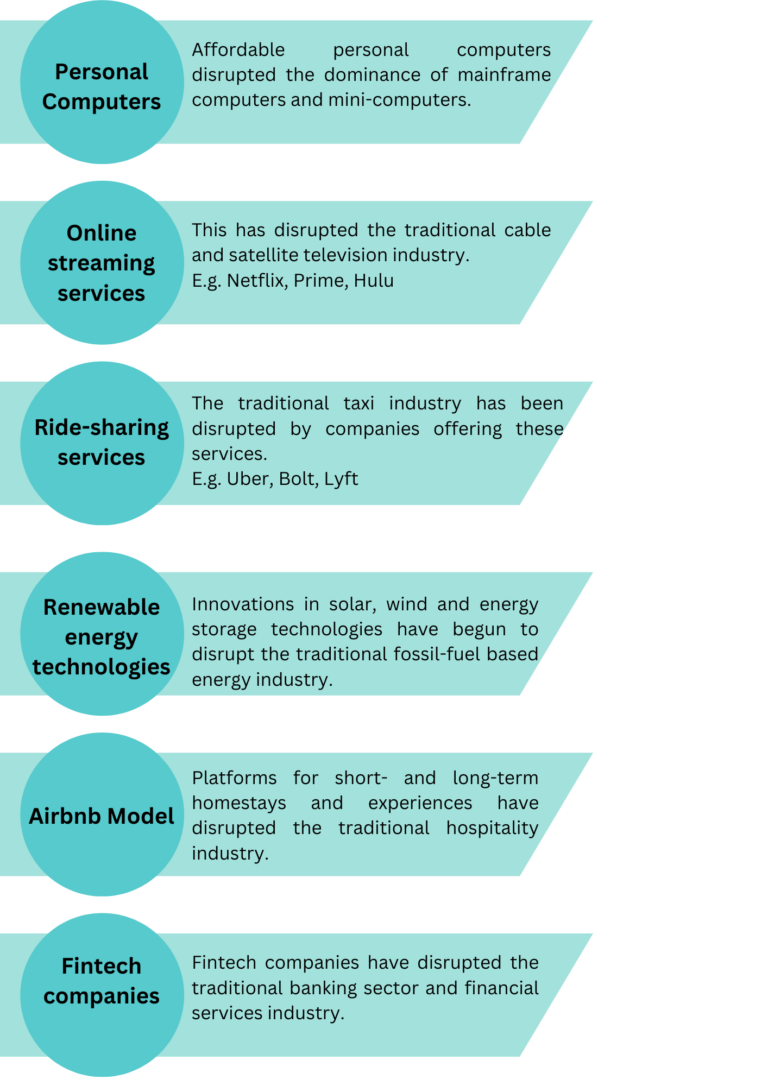
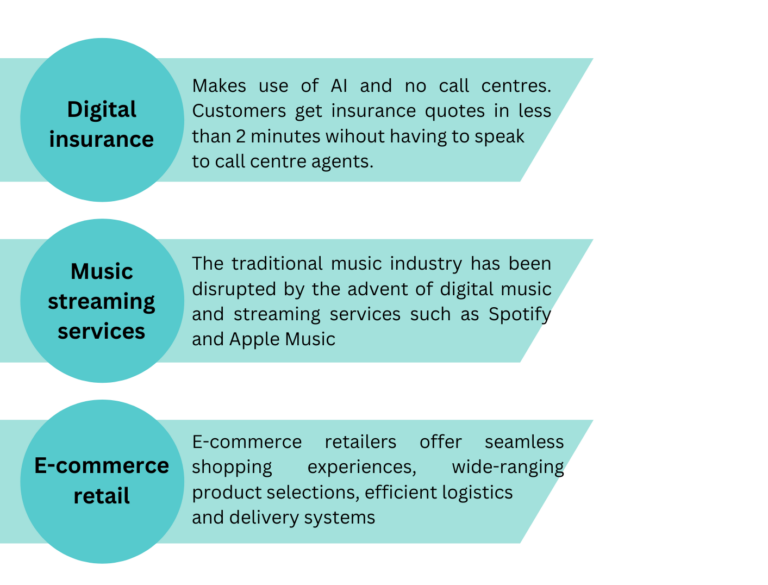
Overall, the article outlines the concept of disruptive innovation and how it can upend the status quo, ultimately transforming the market structure of an industry or many interconnected industries. In a competitive landscape, well-established companies are becoming challenged by disruptive innovations—they must adapt or risk becoming obsolete. Companies must proactively identify and respond to these disruptive threats by adapting their business models or investing in new technologies and ventures. Without embracing a mindset of disruptive innovation, they risk significant losses.
But what does this mean for innovators? From the perspective of an innovator, the possibility of creating and developing a disruptive innovation represents a significant opportunity to displace the leading players in a market, challenge the status quo, change consumer behaviour and positively influence society by addressing unmet needs or solving problems in new ways. In a world of constant technological advancement, innovators and entrepreneurs must continuously strive to maintain their competitive edge by thinking outside the box and seeking unexplored market opportunities. As new entrants, they need to inspect and explore the bottom of their respective markets and look beyond the existing customer bases of well-established firms to niche areas. In the ever-evolving landscape of disruptive innovation, the call to action for innovators is clear: embrace change, be observant, challenge the status quo, and unleash the full potential of their visionary ideas to shape the future.
References
Christensen, C. (1997). The Innovator’s Dilemma: When New Technologies Cause Great Firms to Fail. Boston, MA: Harvard Business School Press.
Christensen, C.M., McDonald, R., Altaman, E.J., and Palmer, J.E. (2018). Disruptive Innovation: An Intellectual History and Directions for Future Research, Journal of Management, 55(7), 1043-1078.

By: Tracy Khuzwayo
What do birth control pills, plastic bags, and Google Glass all have in common? Despite their innovative brilliance, they all fall short of one critical element: understanding the human experience. While birth control pills revolutionised family planning, their initial development often overlooked the lived experiences of women in diverse cultural and economic contexts. Similarly, plastic bags prioritised convenience but ignored their long-term environmental impact, and Google Glass failed to consider social acceptance and practical usability of their glasses. These examples underscore a common pitfall of innovation: a lack of human-centric design. This article focuses on the importance of empathy-driven innovation in designing sustainable and meaningful solutions by engaging communities through co-creation and understanding their lived experiences.
Innovation isn’t just about technological breakthroughs, product development or creative ideas; it can be expanded to include social innovation and new ways of working with communities. Nonetheless, all types of innovation require empathy — a deep understanding of people’s needs, desires, and lived experiences (Brown, 2009). In a world teeming with social, environmental, political, and economic challenges, empathy-driven innovation offers a pathway to meaningful, well-considered, sustainable solutions (Nussbaum, 2001). Empathy-driven innovation can be incorporated across all spectrums of innovation (such as social, technological or disruptive innovation) and solutions design.
DISSECTING EMPATHY IN INNOVATION
As an African rooted in the concept of ubuntu, I believe it wonderfully captures the essence of empathy. Ubuntu transcends mere understanding. Its philosophy — “I am because you are” — emphasises interconnectedness, reminding us that our humanity is tied to one another’s well-being (Mbiti, 1991; Tutu, 1999).
Empathy in innovation embodies this interconnectedness, creating a bridge between solution creators and their intended users. Traditional innovation often adopts a top-down approach, assuming the needs of users or communities without involving them (Kolko, 2015). Empathy-driven innovation flips this narrative by co-creating solutions alongside communities, ensuring they are rooted in lived realities rather than abstract or biased assumptions (Nussbaum, 2001).
THE BENEFITS OF CO-CREATION
Having worked in under-resourced communities across South Africa for almost a decade, I have witnessed the power of empathy-driven innovation. I have also seen how its absence can undermine even the most well-intentioned initiatives. Many organisations fail because their solutions are based on assumptions rather than authentic engagement (IDEO, 2015).
When communities are meaningfully involved in co-creating solutions, some of the transformative benefits include (Design Council UK, 2015):
Co-creation strengthens community trust in organisations and fosters solidarity. Solutions are not imposed but owned, increasing buy-in and long-term commitment.
Fostering Innovation and Inclusivity
Empathy-driven innovation promotes diverse perspectives and inclusivity, resulting in solutions that are creative, equitable, and culturally relevant.
Iterative processes allow organisations to receive feedback, adapt quickly, and avoid missteps that often result in costly failures.
Through workshops and training, communities build new skills, further empowering them to sustain and expand on innovations.
EMPATHY IN ACTION: A STEP-BY-STEP GUIDE
I had the privilege of being part of an empathy-driven social innovation sparked by the community of Cato Manor, Durban. This historically vibrant, multicultural community — disrupted by apartheid’s Group Areas Act — now grapples with systemic challenges like unemployment, high population density, and crime. To address these issues, a group of stakeholders, mostly composed of non-profit organisations and public institutions, came together to form a Community of Practice (COP).
According to Wenger (2011), a COP consists of a group of people who come together because they share common interests, challenges or goals. He further goes on to elaborate that these groups are built on shared experiences, collaboration and a mutual commitment to learning and problem-solving. They engage in discussions, share knowledge, and participate in activities that support their shared purpose. Such communities can exist across organisations or within a single organisation and are fuelled by members’ genuine motivation to grow, innovate and strengthen their collective understanding (Wenger, 2011).
The Cato Manor COP’s mission is to foster partnerships that improve the lives of community members while ensuring initiatives are sustainable and meaningful. The key to their success? Grounding every step of the process in empathy. Instead of saying, “I think, so I will do,” we practiced, “We have spoken, we have agreed, and therefore we will do.” This empathetic shift empowered the community to feel a sense of ownership, relevance, and pride in the solutions they helped design.
The following steps (adapted from IDEO, 2015), which inspired the evolution of the Cato Manor COP, are vital for designing empathy-driven innovation:
Use ethnographic research and participatory methods to build a rich understanding of community culture, structure, and needs (Kretzmann & Knight, 1993). For example, in Cato Manor, initial research was conducted through a needs assessment survey and community interviews validated by members to ensure accuracy and inclusivity.
Engage the community in co-creating solutions by hosting brainstorming sessions and think tanks. Regular meetings provide opportunities for feedback and adaptation, and also assist with the building of trust amongst diverse organisations. In Cato Manor, the COP’s inclusive approach ensured ideas were reviewed and refined collaboratively. In July 2024, the COP hosted a learning lab where members analysed research findings and shared key learnings and actionable insights. The session was facilitated by Innovate Durban’s Research Team, a key member of the COP.
Align solutions with the community’s cultural, social, and economic realities. In Cato Manor, communication materials were shared in accessible formats, including posters, WhatsApp messages, and visual aids, ensuring inclusivity across literacy levels.
Prototype solutions and test them in real-world scenarios. For example, the COP hosted a community expo in November 2024 (Day Two of Innovate Durban’s Innovation Festival) to share its work, gather feedback and network with the COP and the community at large. This event highlighted successes and revealed areas for improvement, laying the groundwork for future initiatives.
Empower communities by providing training and leadership opportunities. The COP nominated local champions to key positions (in the form of a steering committee), fostering a sense of pride and shared responsibility. A sense of accountability was also established through the co-creation of a code of conduct, which applies to all members.
Evaluate both quantitative outputs and qualitative outcomes. The COP’s planned annual evaluation workshops will ensure that initiatives evolve alongside the community’s needs. The next evaluation workshop will be taking place in January 2025.
Transparent, ongoing communication channels — such as WhatsApp groups and community hubs — enable the COP to adapt its solutions in real time.
THE ROAD LESS TRAVELED
Empathy-driven innovation is not without its challenges. Balancing community input with scalability can be daunting, and limited resources often test the viability of grassroots efforts (Buur & Matthews, 2008). Resistance from stakeholders unfamiliar with participatory approaches is another hurdle.
Yet, the rewards far outweigh these challenges. Solutions grounded in empathy are not only more effective but also more enduring. Even with resource constraints, small steps like community focus groups can ensure innovation remains inclusive and relevant (Buur & Matthews, 2008; Prahalad & Ramaswamy, 2004).
CONCLUSION
Empathy-driven innovation represents the future of sustainable problem-solving. By designing solutions with and for communities, we can address systemic inequalities, amplify marginalised voices, and create systems that are equitable and resilient.
As the world faces pressing challenges like climate change, inequality, and public health crises, empathy must be at the heart of every solution. It ensures that innovations are not just impactful but profoundly human.
Let us commit to building a future where every solution is grounded in understanding, compassion, and collaboration. Together, we can design innovations that not only solve problems but also honour the humanity of those they serve.
REFERENCES

By: Patrick Martel and Tamisha Gengayah
In a world where innovation drives progress, how do we ensure we’re not leaving opportunities on the table? This question took centre stage at Innovate Durban’s recent Stakeholder Forum, where partners from academia, civil society, government, and the private sector came together to chart the course for innovation in 2025 and beyond. Their insights reveal not just challenges, but transformative opportunities for change.
Our stakeholders pinpointed two fundamental gaps undermining innovation potential. First, the severe underinvestment in early STEM education. Research backs their observation – the World Economic Forum (2022) found that countries with strong early STEM education programmes show up to 40% higher rates of innovation output in subsequent decades. While we pour resources into tertiary education and workplace innovation, we’re squandering the chance to nurture innovative thinking when it matters most – in young minds during their formative years. Without early exposure to problem-solving and critical thinking skills, many potential innovators are left without the foundational knowledge needed to pursue careers in high-impact fields.
The second critical gap identified by stakeholders is the widening chasm between academic preparation and workplace demands (Swiss South African Cooperation Initiative, 2024). Universities and industries operate in isolation rather than synergy, creating a skills mismatch that cripples innovation potential. This disconnect hits hardest in resource-constrained environments, where small and medium enterprises struggle to access vital technical expertise and mentorship. Bridging this gap requires stronger collaboration, including graduate development programmes and internship opportunities.
Research from African innovation ecosystems demonstrates that sustainable change requires both systemic transformation and stakeholder buy-in. Studies have shown that effective innovation requires changes that improve system resilience while being sustainable beyond immediate catalysts for change (Adesida, Karuri-Sebina & Thaver, 2021).
Our stakeholders didn’t just identify problems – they proposed four transformative changes that could revolutionise our innovation ecosystem:
Stakeholders called for a complete reimagining of how we introduce innovation and STEM concepts to young learners. Their vision goes beyond curriculum tweaks – it’s about embedding creative problem-solving into the DNA of early education. The MIT innovation ecosystem model validates this approach, showing that when innovation capacity (I-Cap) and entrepreneurial capacity (E-Cap) are developed early, they create a powerful foundation for future innovation (Budden & Murray, 2019).
Forum participants proposed a radical shift in how we share resources across sectors. Rather than institutions struggling alone, they envisioned a network of cross-sectoral partnerships that could amplify impact, particularly in marginalised areas where Technology Transfer Offices currently falter. Recent research confirms this approach, showing how intermediaries can dramatically boost innovation by connecting diverse actors and facilitating knowledge transfer (Sultana & Turkina, 2023).
Stakeholders identified Small, Medium, and Micro Enterprises as the untapped powerhouse of our innovation ecosystem. Research shows 82% of SMMEs already innovate through ‘doing, using and interacting’ approaches (Lukhele & Soumonni, 2021). Our forum participants proposed a comprehensive support system that would unleash this potential through targeted funding, technical guidance, and structured mentorship programmes.
Their vision aligns with the World Economic Forum’s framework, which emphasizes that sustainable change requires both accountability and autonomy – giving institutions the freedom to innovate while maintaining clear outcome measures (Barber & Klein, 2016).
Forum participants advocated for a fundamental shift from short-term interventions to sustained, long-term programmes. They proposed a sophisticated monitoring system that would track impact years beyond programme completion, enabling data-driven decisions about resource allocation and programme design.
Our stakeholders emphasized that these challenges form an interconnected web. Research from the MIT Innovation Initiative supports their perspective, showing that successful innovation ecosystems thrive on integrated approaches that connect multiple stakeholders and sectors (Murray et al., 2023).
The Global Innovation Index 2024 reinforces our stakeholders’ emphasis on “innovation brokers” – organisations that catalyse connections across the innovation ecosystem (WIPO, 2024). These intermediaries drive success by:
Forum participants identified human capital development as the cornerstone of innovation success. Research confirms their insight – innovation ecosystems in developing economies thrive when they prioritize human capital development and strong social networks (Cornell University, INSEAD, & WIPO, 2020). The Global Innovation Index has consistently shown that countries that invest in human capital and foster robust innovation networks see stronger innovation outcomes, particularly in emerging economies.
Our stakeholders envision:
Our Stakeholder Forum revealed both the challenges and opportunities ahead. Success demands:
What do you think are the biggest missed opportunities in innovation? How would you propose to unlock them? Share your thoughts, and let’s continue this important discussion about shaping the future of innovation in our region.
This article is based on insights from Innovate Durban’s February 2025 Stakeholder Forum, which brought together diverse voices from across the innovation ecosystem. To learn more about how you can get involved in shaping the future of innovation in our region, connect with us.
Adesida, O., Karuri-Sebina, G. and Thaver, K. (2021). Strengthening Innovation Ecosystems in Africa: Seeking out the systemic changes in the wake of COVID-19. UJ-TRCTI Working Paper Series (WP 2021-02). University of Johannesburg: South Africa.
Barber, M., & Klein, J. (2016). Unleashing Greatness: Nine Plays to Spark Innovation in Education. World Economic Forum White Paper, Global Agenda Council on Education.
Budden, P., & Murray, F. (2019). An MIT Framework for Innovation Ecosystem Policy: Developing policies to support vibrant innovation ecosystems. MIT Innovation Initiative Working Paper, October 2019.
Cornell University, INSEAD, & WIPO. (2020). The Global Innovation Index 2020: Who Will Finance Innovation? Ithaca, Fontainebleau, and Geneva.
Lukhele, N., & Soumonni, O. (2021). Modes of innovation used by SMMEs to tackle social challenges in South Africa. African Journal of Science, Technology, Innovation and Development, 13(7), 829-837.
Murray, F., Budden, P., & Bilska, M. (2023). Innovation ecosystems: A new approach to accelerating technology development and innovation in materials. MRS Bulletin, 48(1), 27-35.
Sultana, N., & Turkina, E. (2023). Collaboration for Sustainable Innovation Ecosystem: The Role of Intermediaries. Sustainability, 15, 7754.
Swiss South African Cooperation Initiative (SSACI). (2024). Identification of Skills Gaps in South Africa: A Technical Research Report. Produced for the Department of Higher Education and Training as part of the Labour Market Intelligence research programme.
World Economic Forum. (2022). Schools of the Future: Defining New Models of Education for the Fourth Industrial Revolution. World Economic Forum White Paper.
World Intellectual Property Organization (WIPO) (2024). Global Innovation Index 2024: Unlocking the Promise of Social Entrepreneurship. Geneva: WIPO. 10.34667/tind.50062

By Miliswa Sipambo
“As a child I was told I had to be 10x better than my white counterparts because I was black. 20 something years later I repeated the same thing to my own children. Another 20 years later (40 are you counting?). My clients tell me how much they struggle in the job market, why? Because they’re black!” (Sutherland, 2021). A reflection that echoes through generations of Black women’s professional experiences.
We’re told we can have it all: career, family, personal growth. But for many Black professional women in South Africa, the idea of “having it all” is not just a dream; it’s a demand. Career pivots among Black women are often framed as personal choices, but they are frequently systemic responses to exclusion, inflexible work cultures, and racialised expectations. We live in a country where many Black professionals are first-generation corporates, navigating unfamiliar spaces while carrying the emotional weight of communal responsibility. Add in gender dynamics, economic volatility, and social expectations and it’s easy to feel like you’re falling behind, even when you’re doing everything you can just to stay afloat.
As a marketer, I know that storytelling is everything. But making sense of my own story, especially the pivots, the pauses, and the feeling of being stuck despite outward success, has been harder. I realised I was measuring success using someone else’s script. That’s when it hit me: my journey wasn’t just personal. It reflected deeper systemic gaps that many women of colour face in the workplace, gaps that also present opportunities for innovative thinking and career reinvention.
The Innovation Lens: Three Critical Gaps
My experience navigating career transitions has taught me to view professional challenges through an innovation framework. Just as successful innovations identify and solve unmet needs, understanding the barriers Black women face reveals opportunities for creative career solutions.
There are three major gaps that shape this experience:
Understanding these gaps didn’t just reshape how I view my own career; it transformed how I approach my work as a marketer. My journey has made me hyper-aware of authenticity. I’m not just selling a product or service; I’m speaking to real people, many of whom are juggling invisible battles of their own. This emotional intelligence has become a professional asset that drives more effective, human-centred campaigns.
The Hidden Costs: When Success Feels Like Survival
The data tells a stark story. According to McKinsey’s 2024 “Women in the Workplace” report, the largest study of women in corporate America, while women have made gains in senior leadership roles, progress remains fragile, especially for women of colour who continue to be underrepresented at every level. For every 100 men promoted to manager positions, only 81 women receive the same opportunity, and this gap is even wider for women of colour.
But statistics don’t capture the emotional toll of navigating constant reinvention. The professional challenges that arise from systemic barriers can feel overwhelming, especially in creative fields like marketing, where innovation and strategic thinking are non-negotiable, yet the pressure to constantly prove our worth while managing personal responsibilities can feel insurmountable.
This is where many women of colour find ourselves at a crossroads, not because we lack ambition, but because the road ahead wasn’t built with our realities in mind. What emerges is what I call a “career identity crisis”: the unsettling moment when you question whether you’re living out your purpose or just surviving your circumstances.
Take brand strategy, for instance. I’ve had to learn to be more intuitive and empathetic in how I build campaigns because I know what it feels like when messaging doesn’t reflect a lived reality. My journey has made me hyper-aware of authenticity. I’m not just selling a product or service, I’m communicating to real people, many of whom are juggling silent battles of their own. Professionally, this emotional intelligence has become an asset. I’ve developed a sharper lens for spotting tone-deaf campaigns, exclusionary messaging, and workplace cultures that lack psychological safety. Personally, it’s helped me redefine what growth and value look like.
The Professional Paradox
The professional toll of navigating these barriers isn’t always visible, but it’s deeply felt. It manifests as:
This pressure is especially acute for Black women, who often carry the weight of expectations shaped by both family legacy and societal bias. As executive coach Janice Sutherland notes, many of us were taught from childhood to be “ten times better” just to be seen as equal. Failure isn’t just personal, it feels collective, tied to the hopes of those who sacrificed for our success.
The “strong Black woman” trope, while meant to celebrate resilience, often reinforces silence and self-neglect. Over time, success becomes so intertwined with titles and roles that many of us ask: Who am I without the job? If I pause, have I failed?
From Survival to Strategic Innovation: A Practical Framework
Recognising these gaps and the emotional toll of navigating them shifted how I define success and how I show up professionally. So, whether you’re mid-pivot, burned out, or simply feeling misaligned, here are a few action strategies that have helped me and others move from survival mode to something more sustainable:
Your winding career path isn’t a flaw; it’s a feature. Research shows that career pivots and disruptions are increasingly common, especially in emerging economies where social and financial responsibilities intersect (McKinsey & Company). The ability to adapt, reinvent, and pivot has become a critical professional skill. Your experience navigating uncertainty gives you an edge in environments that demand flexibility and creative problem-solving.
As Black women, we bring powerful assets to the table: cultural insight, emotional intelligence, and resilience forged through navigating complex systems. These aren’t “soft skills”, they’re competitive advantages in an increasingly diverse marketplace. Use your lived experience to inform campaign ideation, audience insights, and content creation. The more authentic your perspective, the more human and effective your work becomes.
You can’t always control workplace culture, but you can create spaces where you feel seen and supported. This means:
Success doesn’t have to mean climbing the traditional corporate ladder. Redefine it based on:
Rest is not a luxury, it’s a strategic necessity. Burnout often appears as quiet numbness, creative blocks, or growing detachment from work. As Sutherland emphasises, the “strong Black woman” trope isn’t empowering, it’s exploitative, normalising the absence of support while weaponising resilience as a productivity tool.
Build intentional pauses into your career: mental health days, sabbaticals, or adjusted workloads that match your capacity. These aren’t career setbacks, they’re strategic investments in your long-term success.
Innovation Through Authenticity: The Competitive Edge
My career transitions have taught me that authenticity isn’t just personally fulfilling, it’s professionally advantageous. The emotional intelligence developed through navigating systemic barriers has sharpened my ability to:
This isn’t about exploiting personal struggles for professional gain, it’s about recognising that our lived experiences provide valuable market insights and leadership capabilities that many organisations desperately need.
The Innovation Opportunity: Reshaping Professional Norms
Career transitions for Black women aren’t just personal journeys; they’re opportunities to innovate professional norms. Every time we:
We’re not just advancing our own careers; we’re designing new models that benefit future generations of professionals from underrepresented backgrounds.
Embracing the Journey, Not Just the Destination
Life and career don’t always move in sync, and for many of us, especially Black women navigating underrepresented spaces, they were never meant to. But within that disconnect lies the opportunity to rebuild not just your career, but your sense of self and impact on your professional landscape.
Every pivot, pause, and sideways step has taught me that success is not a fixed destination; it’s a feeling of alignment. It’s the ability to rest without guilt, lead with authenticity, and show up whole in spaces that were never designed with you in mind. The messy middle isn’t a detour; it’s where our clarity and innovation are forged.
Yes, the pressure to keep up is real. The emotional and professional costs are heavy. But so is the power of redefining success on your own terms and building a version of your story that honours both your ambition and your humanity.
I used to think success meant following a straight path. Now, I understand it’s about creating one and refusing to measure my worth by systems that were never built for me in the first place.
For innovators and entrepreneurs reading this: your diverse experiences aren’t obstacles to overcome, they’re competitive advantages to leverage. Your non-linear path isn’t a weakness; it’s proof of your adaptability and strategic thinking. Your authenticity isn’t a professional risk; it’s your greatest asset in building meaningful connections and driving real impact.
So no, I’m not where I thought I’d be. But I’m exactly where I need to be. And that story? It’s still unfolding, with more courage, more intention, and more truth than ever before.
References
McKinsey & Company and LeanIn.Org. 2024. Women in the Workplace 2024: The 10th-anniversary report. Available: https://www.mckinsey.com/featured-insights/diversity-and-inclusion/women-in-the-workplace
Sutherland, J. 2021. Various leadership insights and coaching perspectives. CEO of This Woman Can. Available: https://janicesutherland.com/

By Patrick Martel and Tamisha Gengayah
At the launch of the 2025/26 State of Innovation in KwaZulu-Natal Technical Report, someone in the audience asked: “How does this report relate to the National System of Innovation?”
It’s the right question to ask. South Africa’s innovation policy architecture is built around the National System of Innovation (NSI) as its organising frame. The 1996 and 2019 White Papers on Science, Technology and Innovation; the 2022–2032 Decadal Plan; the National Advisory Council on Innovation (NACI); the National Research Foundation; the science councils; the Technology Innovation Agency – all of these sit within, or speak to, a national system. So if you produce a provincial innovation report, it’s reasonable to want to know how it fits.
The short answer is that the provincial report does not sit outside the NSI, beside it, or beneath it. It sits inside it – and it works at a resolution that the national-level instrumentation finds genuinely difficult to reach on its own.
The longer answer is what this piece is about.
What we mean when we talk about a system of innovation
The phrase “national system of innovation” was popularised in the late 1980s and early 1990s by Bengt-Åke Lundvall, Richard Nelson, Christopher Freeman and others working on what determines whether national economies produce innovation, diffuse it, and capture value from it (Lundvall, 1992; Nelson, 1993; Edquist, 1997). Their answer was that innovation is not the output of any single firm, university or government agency working in isolation. It is the outcome of interactions between many actors: firms, universities, research institutes, government departments, financial institutions, regulators, civil society organisations and the populations of skills and capabilities those actors draw on. Where the interactions work well – where information flows, where skills move, where finance follows opportunity – innovation results. Where they don’t, it doesn’t.
South Africa adopted this framing formally in the 1996 White Paper on Science and Technology (Department of Science and Technology, 1996), and re-affirmed it in the 2019 White Paper on Science, Technology and Innovation (Department of Science and Innovation, 2019). The Decadal Plan 2022–2032 (Department of Science and Innovation, 2022) operationalises it across five thematic priorities: modernising manufacturing, agriculture and mining; unlocking the digital economy; advancing health and energy innovation; building state capacity through innovation; and addressing climate change as a societal grand challenge. The framework treats innovation as relational rather than linear, as systemic rather than institutional, and as something that requires attention to the whole ecology, not just the inputs (Manzini, 2012).
That has a specific implication for measurement. If the system is relational, then measuring it requires attention to where the actors actually are and how they interact. And in a country with significant geographical disparities – in industry mix, in higher education capacity, in R&D intensity, in skills concentration, in market structure – the question of where things happen turns out to matter enormously.
Why provinces are part of the system, not below it
The 2019 White Paper makes this explicit (Department of Science and Innovation, 2019). Section 4.9 sets out a policy intent: “Increase the spatial footprint of innovation in South Africa.” It acknowledges that “innovation-support institutions remain concentrated in the major metropolitan areas” and commits to “support for regional and local systems of innovation” by bringing in “local government, regional development agencies, local chambers of commerce and community-based entrepreneurs.”
The Decadal Plan picks this up and runs with it (Department of Science and Innovation, 2022). Provincial and local governments are expected to contribute more actively to STI funding. Local innovation ecosystems – walk-in centres, living labs, science centres, local incubators – are envisaged as part of the architecture. A “no wrong door” policy is proposed for provincial and local government.
In other words, the policy architecture of South African innovation explicitly treats provinces not as administrative sub-units that consume national-level outputs, but as sites where the system itself takes shape. The Decadal Plan’s monitoring and evaluation framework is committed to picking up provincial indicators alongside national ones, and the recently established Moses Kotane Research Institute in KwaZulu-Natal is one of several institutional developments operationalising that intent.
This matters for the measurement problem. If the NSI is a system whose properties emerge from the interactions of many actors, and if those actors are distributed unevenly across the country, then any measurement framework needs both the national view and the provincial view to capture what it is trying to capture.
What NACI does – and what it does well
NACI’s annual STI Indicators Report is the principal instrument through which the South African government tracks the performance of the NSI. The report has been published in seven editions between 2019 and 2025 (National Advisory Council on Innovation, 2019, 2020, 2021, 2022, 2023, 2024, 2025). It draws on data from the HSRC’s National Survey of Research and Experimental Development, the DHET research outputs database, Stats SA, the Department of Basic Education, the Companies and Intellectual Property Commission, ICASA, SARS and a number of international comparator datasets. It covers R&D investment, human capital, innovation activities and innovation outputs across the South African Innovation Scorecard’s framework conditions.
It also has, in each edition, a dedicated provincial section. In 2019 this section was relatively narrow – three subsections covering provincial R&D performance, government STI funding by province, and provincial innovation and entrepreneurship. By 2025 it had grown into a substantial Chapter 7, covering provincial economic structure, R&D intensity, bibliometrics, educational attainment, mathematics and physical science performance, internet access, government innovation support organisations, manufacturing employment by technology intensity, provincial exports by technology intensiveness, SAHPRA medical device licences by province, SEDA incubators by sector and technology tier, and TIMSS provincial scores. The trajectory over six years is towards more sophisticated and more analytically demanding provincial measurement.
What NACI has built with this chapter is a national-level provincial baseline. Every province in the country can now be measured on the same indicators with the same data sources at the same point in time. The provincial comparisons that anchor much of the analysis in any provincial innovation report – KwaZulu-Natal at 14–16% of national GDP, third nationally on absolute R&D, second nationally in medium-high-tech manufactured exports, leading nationally on Living Lab footprint – all rest on NACI’s cross-provincial comparator work. Without that baseline, no provincial publication could make defensible inter-provincial claims.
The 2023 edition is also notable for something else (National Advisory Council on Innovation, 2023). In its provincial chapter, it observes that “most of the data is not available at the provincial level” and proceeds on the basis that the indicators it can present provincially are a selection from a much larger national framework that does not always disaggregate cleanly. It is an honest and important methodological observation. It is also the point at which a dedicated provincial publication finds its place.
What a provincial publication does on top
The KZN State of Innovation 2025/26 Technical Report is one such publication (Martel and Gengayah, 2026). It is now in its seventh edition, produced by Innovate Durban, and funded by the eThekwini Municipality. The 2025/26 edition organises 40 active indicators across five categories – People, Infrastructure, Investment, Ecosystem and Impact – and is built explicitly on the OECD Oslo Manual (4th edition, 2018; OECD/Eurostat, 2018) operationalised at provincial level through NACI’s framework. The report’s methodology chapter is direct about this: NACI’s provincial measurement framework “supplies the indicator categories and the inter-provincial comparator logic this report applies.”
Within that frame, the provincial report does a number of things that the national-level provincial chapter is not designed to do.
It extends the indicator set. The 40 indicators in the 2025/26 edition include eleven measures of the human capital pipeline running from NSC scale through TVET engineering performance to doctoral SET graduation; seven Infrastructure indicators covering both school and digital infrastructure with urban-rural splits; seven Investment indicators with multi-sector R&D analysis; four Ecosystem indicators including a Living Lab profile and a funding-support directory; and eleven Impact indicators spanning technology-intensive employment, sectoral employment, wage structure, youth employment and knowledge production. Many of these draw on the same primary sources NACI uses, but they extract provincial-specific dimensions that the national report does not present in detail.
It adds analytical depth. The report applies three layers within each category. Layer 1 is the international measurement convention via OECD/NACI: every indicator is benchmarked against the other eight provinces and the national aggregate, with rankings, shares, compound annual growth rates and distance-to-frontier metrics. Layer 2 is a KwaZulu-Natal-specific sectoral lens that admits three sectors – logistics and port-linked services, agri-food and agro-processing, and creative industries – into deeper analysis where the province has structural sectoral characteristics that a national framework cannot consistently capture for every province. Layer 3 is the descriptive statistical work – compound annual growth rates over sub-periods, standard deviations of provincial distributions, linear trend fits and R-squared values – that turns indicator levels into trajectories.
It goes below the province. The Innovation Support Facility Register, built and maintained by Innovate Durban, currently captures 18 KZN facility entries across nine recognised facility types and disaggregates these by district. Five KwaZulu-Natal districts – uThukela, iLembe, uMkhanyakude, Zululand and Amajuba – have no confirmed innovation facility presence; the report makes this finding explicit and reads it against the province’s economic and demographic profile. The Funding-Support Mechanism Map captures 95 KZN-anchored funding instruments and a further 355 nationally available instruments accessible to KZN innovators, with a compositional analysis (54.7% advisory, 33.7% capital) that no national report could feasibly carry for every province.
It introduces an organising analytical lens. The 2025/26 edition’s central argument is that KwaZulu-Natal’s innovation challenge is not principally one of scale. On absolute participation measures, the province sits where its population and economic weight would predict: the largest NSC examination cohort in the country, third nationally on total R&D expenditure, a leading research university, the second-largest formal employment base. On intensity, throughput and value-capture measures, the position falls back. R&D intensity ranks seventh of nine provinces. SET graduation per capita sits below its own 2015 starting level. Business sector R&D has contracted in real terms at approximately 1.6 times the national rate over nine years. The conversion-failure framing reads the cross-category data through four structural mechanisms – concentration, composition, throughput and value capture – and makes sense of patterns that only become visible when provincial data is analysed at this depth.
None of this would be possible without the underlying NACI work. NACI provides the national benchmarks, the cross-provincial comparator structure, the methodological alignment to the OECD, and the published series for indicators that the provincial report extends and elaborates. The provincial publication is, in a precise sense, a downstream application of the national measurement system.
Together: a more complete view of the system
This is the answer to the question that was asked at the launch. The KZN State of Innovation Technical Report does not relate to the National System of Innovation by sitting outside it or alongside it. It is part of the NSI’s measurement architecture, working at provincial resolution, drawing on the same data foundations as NACI, using NACI’s framework as its baseline, and extending the analysis where provincial detail makes the difference.
The result is a more complete picture of a system that the 1996 and 2019 White Papers describe as inherently spatial. NACI provides the national lens with provincial summary; the provincial publication provides the provincial lens with district and sector detail. The two layers complement each other. They do not duplicate; one embeds within the other.
That embedding has practical consequences for innovation policy. Provincial and metropolitan government departments planning innovation interventions need provincial-resolution evidence on where the system is concentrated, where it is composed of which actors, where throughput is failing across transitions, and where value is being captured versus where it isn’t. They need data that aligns to national reporting so that provincial interventions can be benchmarked and assessed. And they need analytical layers that extract meaning from the indicator levels rather than presenting them as endpoint metrics.
The provincial publication is built to provide that. It is one input among many – university planning, science council strategy, industry investment decisions, civil-society engagement – that together construct what the policy framework calls “the regional and local systems of innovation.” It works because NACI provides the foundation it builds on. NACI’s national framework works better because provincial publications like KZN SOI extend it at the resolution provincial actors need.
What this means for KwaZulu-Natal
For KwaZulu-Natal specifically, the implication is that the next steps in strengthening the provincial innovation system depend on coordinated action across the three tiers of government, anchored in the evidence that the report assembles. The five priorities for action identified in the 2025/26 edition’s diagnostic brief – spatial inclusion through district-differentiated capacity; recalibration of business R&D and the broader capital architecture; commercialisation infrastructure for the missing middle; fixed-line digital connectivity at productive-use sites beyond the mobile-led layer; and a three-stage human-capital pipeline intervention across TVET, school-to-SET, and doctoral retention – all sit within the NSI’s existing institutional architecture. They do not require new structures. They require provincial resolution applied to the structures that exist.
That is what a provincial State of Innovation publication is for. It is the layer of the NSI that operates at the resolution where most of the actual innovation activity happens: in schools, in TVET colleges and universities, in firms, in research institutions, in incubators, in living labs, in the districts where the population actually lives. It is the layer where measurement has to meet implementation.
For the audience member who asked the question last week: this is how the report relates to the NSI. It is part of it. It strengthens it by extending it. And it answers questions that, by NACI’s own honest admission, the national-level framework is not always positioned to answer on its own.
The 2025/26 Technical Report, the accompanying Diagnostic Brief, and the Innovators of KwaZulu-Natal publication can be accessed via the Innovate Durban website (https://innovate.durban/the-state-of-innovation-in-kwazulu-natal-2025-26/). Engagement with the underlying argument – that the provincial conversion gap is the work that sits in front of provincial innovation policy – is something we welcome. The NSI is not built once and left alone. It is built up, year on year, by every actor who contributes a layer to it.
References
Department of Science and Technology (1996). White Paper on Science and Technology: Preparing for the 21st Century. Pretoria.
Department of Science and Innovation (2019). White Paper on Science, Technology and Innovation. Pretoria.
Department of Science and Innovation (2022). Science, Technology and Innovation Decadal Plan 2022–2032. Pretoria.
Edquist, C. (1997). Systems of Innovation: Technologies, Institutions and Organizations. London: Pinter.
Lundvall, B-Å. (ed.) (1992). National Systems of Innovation: Towards a Theory of Innovation and Interactive Learning. London: Pinter.
Manzini, S.T. (2012). The national system of innovation concept: An ontological review and critique. South African Journal of Science, 108(9/10), Art. #1038.
Martel, P. and Gengayah, T. (2026). State of Innovation in KwaZulu-Natal 2025/26 Technical Report. Durban: Innovate Durban.
National Advisory Council on Innovation (2019, 2020, 2021, 2022, 2023, 2024, 2025). South African Science, Technology and Innovation Indicators Reports. Pretoria: NACI.
Nelson, R.R. (ed.) (1993). National Innovation Systems: A Comparative Analysis. New York: Oxford University Press.
OECD/Eurostat (2018). Oslo Manual: Guidelines for Collecting, Reporting and Using Data on Innovation, 4th edition. Paris: OECD Publishing.
Innovate Durban is a registered non-profit company supporting innovators, innovation and the innovation ecosystem in KwaZulu-Natal through programmes, research, and capacity building. To engage with the State of Innovation publication or explore collaboration opportunities, visit www.innovate.durban or contact the Research team.

By Patrick Martel
“As a government official, I have forgotten how to empathise.”
A participant said that during a recent design thinking workshop with South African government officials. It is the clearest statement I have heard of; a problem most writing on public sector innovation only approaches sideways. The empathy in question is not sentiment but perspective-taking, the capacity to model the experience of the resident on the receiving end of a service. The standard reading would treat the comment as a personal admission. I think the more useful reading is structural. The official had not lost a personal capacity. The system they work within had slowly trained them out of using it.
This matters because it turns the usual framing on its head. The default story is one of deficit. Officials lack the skills, the mindsets, the modern tools of problem-solving, and design thinking is the fix. Run enough workshops, the logic goes, and the public sector will catch up. The trouble is that this story is easier to sell than it is to defend, and it fits the pitch better than it fits what actually happens in the room.
What I have seen across several sessions, including recent cohorts of South African municipal officials, is the opposite. The capacities the workshops claim to teach often turn out to be there already, waiting for an occasion to show themselves. They have simply not been invited.
The deficit story has a long shelf life in public administration. Officials are sent on courses. Toolkits are circulated. Stanford d.school decks travel across continents. The assumption underneath is that good problem-solving lives outside government and has to be imported. Bason (2010), a leading voice in this field through his work at Denmark’s MindLab, argues something more interesting. Public servants already hold the capacities the design world claims to teach them. The routines, incentives, and cultures of their workplaces crowd those capacities out. On this reading, the workshop is not a transplant. It removes a constraint.
Schön (1983) helps explain how. He described the dominance of “technical rationality” in professional life: the prestige model of expertise that prizes applying standard rules to standard cases, and quietly devalues the messier, reflective judgement professionals also carry. Most public sector roles are built around exactly this. Work is split into functional units. Performance is measured against output targets that reward closing a task over asking a better question. The result is not officials without empathy. It is officials whose empathy goes unrewarded, and so falls out of use.
There is a deeper point underneath this, about how government is built. Public organisations are designed around functional specialisation, accountability, and the fair application of rules. The user, meaning the resident or business actually using the service, is rarely the unit the structure is designed around. Departments are organised around the work to be done, not around the experience of the person who needs it done. Weber’s (1922) classic account of bureaucracy made this explicit a century ago, and it still describes most public administration today. These structures struggle in particular with what Rittel and Webber (1973) called wicked problems: messy issues with no clean definition, no settled solution, and no single owner. Municipal service delivery is full of them. So design thinking arrives at a system whose architecture was never user-centred in the first place. The gap is structural before it is personal. When a participant says they have forgotten how to empathise, they are describing something real. They work inside a system that was never built to need empathy as a core part of the job.
What the Workshop Surfaces
Three patterns from recent sessions show what happens when that form is set aside for a while.
The first is the empathy point already made. We mapped what a community member actually goes through when they report a service failure: the back-and-forth, the silence, the workarounds. That exercise produced the comment that opens this article. The participant was not learning to empathise. They were re-meeting a capacity they had set aside in order to do their job.
The second is creative confidence. On day one of a recent municipal cohort, I asked who in the room thought of themselves as creative. Three of the nine officials raised a hand. On day two, after working through empathise, define, ideate, prototype, and test, I asked again. Eight hands went up. Kelley and Kelley (2013) named this effect, building on Bandura’s (1997) work on self-efficacy. The shift over two days is not really about nine officials suddenly acquiring creativity. It is about creativity being, to a large degree, a matter of permission and practice. Smaller exercises show the same thing. Reverse brainstorming, where I ask people to list all the ways they could make a problem worse, almost always produces a moment of visible discomfort in a government room, and then sharper thinking than the standard version of the exercise. The technique (de Bono, 1967) works because it asks people to suspend their professional training for a moment. That is close to what Edmondson (2023) calls intelligent failure: deliberate, well-designed experiments in unfamiliar territory, the kind that risk-averse environments rarely allow.
The third pattern is structural. These officials came from departments that, in normal work, almost never sit in the same room. A pre-workshop needs assessment turned up the same underlying issue from each of them, just described in different departmental language. The meta-challenge, as we framed it, was how to turn siloed municipal operations into integrated, responsive service delivery. Tett’s (2015) anthropological work on siloes captures why this is hard: siloes are not only structural, they are identity-forming. People become defenders of their unit’s view of the world. Here the shared artefacts of the workshop, the wall of notes and maps that Star and Griesemer (1989) called boundary objects, earn their keep. They let officials from different departments point at the same thing without first having to agree on what it means. The workshop also creates, briefly, the kind of psychological safety that Edmondson (1999) identified as the precondition for cross-functional learning, something ordinary departmental work rarely offers. Its least-discussed contribution may simply be that it suspends those identities long enough for a shared problem to come into view.
None of this means the original method is past its sell-by date. The Stanford d.school framing remains the practical backbone of how I work. But the field around it has kept developing. A serious body of critique argues that design thinking can produce small adjustments rather than real systemic change, and the closure of high-profile public sector innovation labs, Denmark’s MindLab among them, has been read as proof of that limit. The constructive response has come from within the field, in approaches like systemic design, mission-oriented innovation, and equity-centred design. These extend the original method rather than replace it, and they push it toward exactly the kind of structural problems this article has been describing.
So the claim here is a narrow one. Two-day workshops do not transform municipalities on their own. But under the right conditions (a cross-functional group, real users in scope, a route to implementation, and cover from leadership), the workshop creates a temporary space where capacities that ordinary work suppresses can resurface. What happens to those capacities afterwards is the longer, harder institutional work. It begins with the simple demonstration that the capacities are there.
Designing for Monday Morning
If the suppression reading is right, the question for any government commissioning design thinking work is not “how do we upskill our officials.” Instead, it is “how do we design the engagement so that what surfaces in the workshop survives Monday morning?” That work starts before the workshop and carries on after it. A proper diagnostic up front. A genuinely cross-functional group in the room. A defined route to implementation at the end. These are design choices, made on purpose by the people commissioning and running the work.
In practice this means more than a project plan. It looks like a named owner inside the relevant department with the authority to commission follow-on work; a small testing budget that does not need a fresh procurement cycle to release; a regular check-in with a senior decision-maker who can clear blockers; and a defined slot in the work the department already does, whether that is the statutory planning cycle, the annual business plan, or the performance dashboard. None of this is out of the ordinary. It is the regular machinery that keeps any piece of work alive, applied to work that too often dies quietly.
What I have seen across these sessions is that when those choices are made well, design thinking does what its advocates have long promised. Empathy comes back to rooms that had quietly let it go. Officials who arrive as departmental representatives leave as people working on a shared problem. Creative confidence, which is far more about context than personality, shows up in measurable amounts. The official who said they had forgotten how to empathise had not lost anything. They were waiting to be asked. Design thinking, done well, is the asking.
References
Bandura, A. (1997). Self-Efficacy: The Exercise of Control. New York: W.H. Freeman.
Bason, C. (2010). Leading Public Sector Innovation: Co-creating for a Better Society. Bristol: Policy Press.
de Bono, E. (1967). The Use of Lateral Thinking. London: Jonathan Cape.
Edmondson, A. C. (1999). Psychological Safety and Learning Behavior in Work Teams. Administrative Science Quarterly, 44(2), 350-383.
Edmondson, A. C. (2023). Right Kind of Wrong: The Science of Failing Well. New York: Atria Books.
Kelley, T. and Kelley, D. (2013). Creative Confidence: Unleashing the Creative Potential Within Us All. New York: Crown Business.
Rittel, H. W. J. and Webber, M. M. (1973). Dilemmas in a General Theory of Planning. Policy Sciences, 4(2), 155-169.
Schön, D. A. (1983). The Reflective Practitioner: How Professionals Think in Action. New York: Basic Books.
Star, S. L. and Griesemer, J. R. (1989). Institutional Ecology, ‘Translations’ and Boundary Objects: Amateurs and Professionals in Berkeley’s Museum of Vertebrate Zoology, 1907-39. Social Studies of Science, 19(3), 387-420.
Tett, G. (2015). The Silo Effect: The Peril of Expertise and the Promise of Breaking Down Barriers. New York: Simon & Schuster.
Weber, M. (1922 [1978]). Economy and Society: An Outline of Interpretive Sociology. Berkeley: University of California Press.

By Amykelani Skhosana
South Africa’s innovation ecosystem is a host to numerous scalable ideas with the potential to change the world, yet far too many of them stall before they reach the market. The journey from prototype to product is riddled with systemic barriers: fragmented policy, constrained infrastructure, and a persistent disconnect between grassroots ingenuity and industrial-grade manufacturing. I have lived this tension across multiple sectors and contexts, from university research laboratories to community makerspaces, and it has shaped everything I believe about what it takes to build scalable, sustainable innovation in Africa.
My career began in data and business intelligence at WesBank, where I was part of a team that managed complex server migrations, data governance frameworks, and IT audit compliance processes. Working across systems that underpinned large-scale financial operations taught me early that innovation without robust infrastructure and governance is fragile. A data pipeline that breaks under load is the same problem at a different scale, as a prototype that cannot survive the transition to manufacturing. The lesson is universal: systems thinking is not optional.
From there, I moved into research at the University of Johannesburg, where I became part of the Meta-Catalysis Research Group and Robotics & 3D Printing Research Sub-Group in the Department of Chemical Sciences. Our work on the Digital Chemical Manufacturing in Africa project brought together chemistry, automation, robotics, and engineering to build a fully automated laboratory (a Chemputer) capable of executing complete chemical synthesis procedures using home-built, open-source hardware and 3D-printed components as inspired by the Cronin Group at the University of Galsgow in Scotland. We were essentially doing what the entire innovation ecosystem needs to do: taking a complex idea, breaking it into its component disciplines, building it iteratively, and proving the concept in the real world. Working under the supervision of Professor Reinout Meijboom, and alongside colleagues from the Department of Mechanical Engineering and Chemical Sciences, I learned that true innovation requires multidisciplinary collaboration and that the gaps between disciplines are often where the most valuable breakthroughs are found.
Today, as a Fabrication Technician at Innovate Durban, I see firsthand through our Innovation Co-Lab in Cato Manor what is possible when we put the right tools, the right mentorship, and the right community into the same room. I also see, every day, how close so many innovators are to something real, and how the absence of integrated systems between ideation and manufacturing stops them from getting there. This article is my attempt to name that gap clearly, and to argue that closing it is not just possible, but urgent.
Are We Providing the Necessary Funding Support Required for Scalable Innovation?
Despite an abundance of promising ideas in South African makerspaces, most prototypes never reach the market. The core problem is not a shortage of creativity. It is a shortage of pathways. Limited access to industrial-grade tools, fragmented supply chains, and the absence of quality control processes mean that even technically sound innovations remain trapped at the prototype stage.
I experienced this directly during my time at the University of Johannesburg. Components and chemicals for our Digital Chemistry projects often had to be sourced from Germany, with lead times stretching from three to six months. Waiting half a year for a critical part does not just slow progress, it disrupts reporting cycles, decreases team morale, and sends a signal to funders that the project is stalled. The procurement red tape was not a reflection of the quality of the science; it was a structural failure that innovation infrastructure in South Africa has not yet solved.
Research across African innovation ecosystems confirms that these barriers are systemic. Makerspaces and Fab Labs typically offer 3D printers, CNC machines, and electronics equipment, but they lack the industrial-grade machinery, stable electricity, and sustained funding that would allow them to support the transition to production-scale tooling (Rasoarimanana et al., 2025). Investment deficiencies and weak local supplier networks make sourcing materials for scale expensive and difficult, increasing dependency on costly imports and undermining MSME growth (Dosso et al., 2021).
Early-stage innovators are also rarely designing with manufacturability in mind. In academic and community settings, the focus is rightly on function and proof of concept. But this creates bottlenecks when the time comes to move toward formal production, where costed bills of materials, tolerances, and repeatable processes become critical (Kruger and Steyn, 2024; Rambe and Maime, 2023). Add to this an underdeveloped regulatory and standards landscape for technologies like additive manufacturing, and the result is a system where strong ideas consistently get stuck (Klenam et al., 2025).
How Can We Build a Sustainable Pipeline for Scalable Innovation?
The answer is systemic integration, connecting fabrication technologies, design expertise, and funding at the earliest stages of the innovation process. This is not a theoretical proposition. I have seen what it looks like in practice, and I know it works when we are deliberate about it.
At Innovate Durban, we involve stakeholders across disciplines to prepare innovators not just for prototyping, but for manufacturing and market deployment. Kruger and Steyn (2024) recommend embedding design expertise within makerspaces to align early-stage prototypes with manufacturability through iterative, multidisciplinary workflows. This means training youth not just in how to use tools, but in how to think about production constraints from day one.
Building seamless pipelines from ideation to manufacturing is equally critical. Rambe and Maime (2023) argue for a bottom-up entrepreneurial ecosystem approach where serial entrepreneurs, local industry, and regional infrastructure form a coordinated system to move ideas from prototype to market. Research shows that Fab ƒƒLabs and university makerspaces can function as practice-based pedagogies that build technical and interdisciplinary skills, offering a genuine alternative to traditional education routes (Rasoarimanana et al., 2025; Oladele-Emmanuel et al., 2018).
Addressing the funding gap between prototype and commercialisation is also essential. Several researchers call for dedicated bridging funds and blended finance instruments – public seed funds, matched grants, and public-private partnerships – to support validation, certification, and small-batch manufacture between the prototype and commercial scale (Ssekitoleko and Dhliwayo, 2023; Kah, 2023). My main argument is simple: scalable innovation depends on building these integrated systems of support. Without them, we are asking innovators to win a relay race with no handoff.
The Factory Floor Starts in the Makerspace
Makerspaces are not just idea zones. They are, or should be, the first nodes of a local manufacturing ecosystem. When we limit their role to tinkering and prototyping, we underutilise their real value. When we connect them deliberately to manufacturing infrastructure, funding, and skills pipelines, they become something transformative.
I have seen this potential up close. The Geological Survey I participated in for Ekurhuleni Metropolitan Municipality, working alongside internationally acclaimed geochemist Professor Jan Kramers, reinforced for me that rigorous, applied science in African contexts can generate knowledge and solutions of global significance. The tools do not need to be imported. The expertise does not need to come from elsewhere. What is needed is the infrastructure to develop and deploy it.
A youth who learns 3D modelling today could become a product designer tomorrow, if we build proper systems for them to thrive. A technician who assembles prototypes now could lead a production line in five years, if those systems are strengthened for the future world of work amidst the Fourth Industrial Revolution (4IR). Fab Labs are already demonstrating their links to entrepreneurship, youth and women’s inclusion, and local job creation through skills transfer and small-scale enterprise formation, though scale and sustainability depend heavily on policy support and sustained funding (Oladele-Emmanuel et al., 2018; Naudé, 2019).
As Professor Tshilidzi Marwala (Rector of the United Nations University and Under-Secretary-General of the United Nations) often emphasises, we need to invest in technologies of production. That investment includes hardware and software, yes, but also people, systems, and governance policy. Reviews of additive manufacturing point to its suitability for localised, resource-efficient production in Africa, while also flagging the regulatory, skills, and infrastructural gaps that must be addressed to realise sustainable industrialisation (Klenam et al., 2025). The next wave of African manufacturing innovation will come from makerspaces, empowered by local expertise, academic research, and intentional government support.
Policy Recommendations for Scalable Innovation
Translating the potential of makerspaces into scalable manufacturing outcomes requires coordinated policy interventions across infrastructure, funding, skills, and institutional design. These are not abstract recommendations. They correspond directly to the barriers I have encountered across my own career, from the procurement delays in university research to the skills gaps visible in community makerspaces today. According to the 2024/25 Innovate Durban State of Innovation in KwaZulu-Natal Publication, it is crucial to establish inclusive innovation policies that mitigate disparities between urban and rural areas, promote incentives for private sector R&D investment, and reinforce collaborative partnerships across government, academia, and industry (Martel and Gengayah, 2025).
Government must support localised manufacturing through investment in reliable energy and digital infrastructure, and incentives for local supplier development (Dosso et al., 2021; Klenam et al., 2025). This means prioritising stable electricity, affordable high-speed internet, and logistics networks that reduce import dependence; creating incentive schemes to strengthen domestic supplier networks; and establishing manufacturing hubs co-located with makerspaces and Fab Labs to facilitate the transition from prototype to production.
Fab Labs and makerspaces must be formally integrated into national innovation strategies, with their pedagogical role recognised and linked to certification and accreditation pathways (Rasoarimanana et al., 2025; Oladele-Emmanuel et al., 2018). This requires accrediting makerspace training programmes aligned to national qualifications frameworks, establishing dedicated budget lines for makerspace operations and equipment, and creating a national network with shared standards and coordinated industrial partnerships.
Dedicated 4IR and commercialisation funds, blended finance mechanisms, and matched public-private instruments are needed to finance validation, standards compliance, and initial manufacturing runs (Ssekitoleko and Dhliwayo, 2023; Kah, 2023). Specifically: bridging funds to cover the “valley of death” between prototype and commercial scale; public-private co-investment vehicles that share risk; and matching funds to incentivise private sector engagement in skills development and product validation.
Practice-based curricula, apprenticeships, and university makerspace programmes must teach design for manufacturability and digital fabrication skills from the ground up (Kruger and Steyn, 2024; Rasoarimanana et al., 2025). This means integrating Industry 4.0 competencies into TVET and engineering programmes; developing structured apprenticeship pathways linking makerspace training to formal manufacturing employment; and supporting lifelong learning for existing technicians and makers.
Triple-helix models (government, industry, academia) must be used to coordinate R&D, standards development, and industry uptake (Klenam et al., 2025; Rambe and Maime, 2023). Government should convene risk-sharing partnerships, absorb early-stage risk through guarantees or first-loss capital, and create procurement programmes that reserve contracts for locally manufactured products emerging from makerspace-industry collaborations.
University-industry linkages must be strengthened, intellectual property and commercialisation pathways clarified, and translational funding established to bridge the gap from lab validation to market trials (Kah, 2023; Mhlanga and Salih, 2023). Practical measures include simplifying IP policies to retain inventor incentives, establishing Proof-of-Concept funds for the academic-to-market transition, and strengthening Technology Transfer Offices with dedicated staff and performance incentives tied to commercialisation outcomes.
These six policy areas are mutually reinforcing. Infrastructure enables digital manufacturing. Funding de-risks scale. Skills supply the labour that manufacturing demands. Partnerships coordinate resources for commercialisation. Without coordinated implementation across all six, individual interventions will deliver limited impact (Ssekitoleko and Dhliwayo, 2023; Klenam et al., 2025). As Martel and Gengayah (2025) note, innovation infrastructure and ecosystem coordination remain critical enablers of scalable innovation in KwaZulu-Natal — and this holds true across South Africa and the continent.
Conclusion
To scale innovation locally and across Africa, we must stop separating ideation from implementation. Innovation is not a pitch. It is a process – one that includes design, fabrication, testing, iteration, and finally, manufacturing. I have worked across enough environments to know that the potential is real: in the chemistry lab, in the data warehouse, in the makerspace, in the field. What is missing is not ambition. It is the integrated systems that allow ambition to become output.
The evidence is clear: makerspaces and Fab Labs are vital nodes for grassroots innovation and early-stage product development, but they are necessary yet insufficient for industrial scaling (Rasoarimanana et al., 2025; Kruger and Steyn, 2024). Bridging the gap requires systemic integration of design expertise, manufacturing capacity, targeted funding, and enabling policy. The opportunities presented by Industry 4.0 and digital manufacturing are real – they can democratise production, create quality jobs, and accelerate industrialisation – but only if we address the structural barriers of infrastructure, skills, standards, and market readiness together (Naudé, 2019; Klenam et al., 2025; Dosso et al., 2021).
Let us not just build for the moment, but for scale, sustainability, and for our people. The next wave of African manufacturing innovation will emerge from makerspaces, powered by local expertise, academic research, intentional government support, and private partnerships – if we commit to building the integrated systems that turn prototypes into products, and ideas into industries, in service of the United Nations Sustainable Development Goals and of society.
References
Corsini, L., & Moultrie, J. (2018). The role of makerspaces for crisis-affected communities: Benefits and challenges. 10.5281/zenodo.1344465.
Corsini, L., & Moultrie, J. (2020). Humanitarian makerspaces in crisis-affected communities. Artificial Intelligence for Engineering Design, Analysis and Manufacturing. 34. 1-13. 10.1017/S0890060420000098.
Dosso, M., Hervás, F., Vezzani, A., Vértesy, D. and Varga, A. (2021) ‘The Readiness of Innovation Systems for the Fourth Industrial Revolution (4IR) in Sub-Saharan Africa’, in Innovation in Africa: Emerging Hubs of Excellence. Cham: Springer, pp. 21-48. https://doi.org/10.1007/978-3-030-58240-1_2.
Dougherty, D. (2012). The maker movement. Innovations, 7(3), 11-14.
Kah, M.M.O. (2023) ‘A post-COVID-19 IDEA to strengthen research, innovation, and development in Africa’, African Journal of Pharmaceutical and Pharmacological Sciences, 2(2), pp. 1-10. https://doi.org/10.25259/ajpps_2023_021.
Klenam, D.E.P., Chown, L.H., Papo, M.J., Mwema, F.M., Akinlabi, E.T. and Jen, T.-C. (2025) ‘Toward sustainable industrialization in Africa: the potential of additive manufacturing – an overview’, Frontiers in Manufacturing Technology, 1, Article 1410653. https://doi.org/10.3389/fmtec.2024.1410653.
Kruger, C. and Steyn, A.A. (2024) ‘Developing breakthrough innovation capabilities in university ecosystems: A case study from South Africa’, Technological Forecasting and Social Change, 198, Article 123002. https://doi.org/10.1016/j.techfore.2023.123002.
Martel, P. and Gengayah, T. (2025). The State of Innovation in KwaZulu-Natal Publication 2024/25. Innovate Durban: Durban.
Mhlanga, D. and Salih, M.M. (2023) ‘After Being Left Out of the First, Second, and Third Industrial Revolutions, Is Africa Finally Prepared for the Fourth Industrial Revolution?’, in Advances in African Economic, Social and Political Development. Cham: Springer, pp. 37-62. https://doi.org/10.1007/978-3-031-28686-5_3.
Naudé, W. (2019) ‘New Technology, Entrepreneurship and the Revival of Manufacturing in Africa: Opportunities for Youth and Women?’, Research Papers in Economics, IZA Discussion Paper No. 12121. Available at: https://www.iza.org/publications/dp/12121.
Oladele-Emmanuel, B., Uzoma, C.C. and Emeka, O.C. (2018) ‘Strategic Management: SWOT Analysis of the African Digital Fabrication Laboratories’, in 2018 IEEE International Conference on Engineering, Technology and Innovation (ICE/ITMC). Stuttgart, Germany: IEEE, pp. 1-9. https://doi.org/10.1109/ICE.2018.8436269.
Rambe, P. and Maime, M. (2023) ‘The Impact of 4IR Technologies on Venture Creation and Technology Commercialisation: Insights and Exemplars from an Emerging Economy Context’, in Entrepreneurship and Development in the 21st Century. Cham: Springer, pp. 119-148. https://doi.org/10.1007/978-3-031-37675-7_7.
Rasoarimanana, M.H., Rakotomalala, M.J., Andrianandrasana, L.N. and Razafindrakoto, N.R. (2025) ‘The Scientific and Technological Contribution of African FabLabs: Innovations, Impacts and Perspectives’, Current Journal of Applied Science and Technology, 44(9), pp. 1-18. https://doi.org/10.9734/cjast/2025/v44i94600.
Ssekitoleko, J. and Dhliwayo, S. (2023) ‘Elevating South Africa’s Entrepreneurial Activity in the Fourth Industrial Revolution Era’, Administrative Sciences, 13(9), Article 195. https://doi.org/10.3390/admsci13090195.
*The views expressed in this article are that of the author/s and do not necessarily reflect that of Innovate Durban.

By Chelsea Pillay
What if the biggest barrier standing between your small business and its next hundred customers is not funding, not location, and not connections, but simply the absence of a social media strategy.
In Africa, entrepreneurship has emerged as a critical driver of economic development, yet the conditions that enable or constrain entrepreneurial success remain complex and multifaceted. Social capital and networking have been widely recognised as foundational resources for entrepreneurs. Kristiansen (2004) interprets how the quality of an entrepreneur’s social network, measured by its number, diversity, strength, and dynamics, directly shapes their ability to access motivation, capital, information, and market opportunities. However, the benefits of networking are not equally distributed and is the main basis on which one’s capacity to build and leverage meaningful business relationships are built. In more recent decades, the rise of digital technology has introduced new pathways for entrepreneurial networking and market access across the continent. Ukpere, et al. (2014) argue that social media platforms and ICT infrastructure have become indispensable strategic tools for modern African entrepreneurs, enabling them to reach broader markets, build brand awareness, and participate in both formal and informal economies at reduced cost. Together, these perspectives suggest that entrepreneurial success in Africa is shaped by an interplay between deeply rooted social structures and rapidly evolving digital environments.
According to Lula (2025) businesses require a well curated social media plan, with a coherent budget, that will connect them with their intended audience. This can become daunting for SME’s when having to compete with larger brands. I’ve seen many businesses shy away from the process of starting a social media account but with a few tweaks to their approach this process can become more seamless. This can look like continuous content planning, content creation and performance monitoring.
Ornico, World Wide Worx and Ask Africa (2025) stated that there has been significant platform shifts in South Africa. TikTok has emerged as the fastest-growing platform, particularly among younger users, with its penetration jumping from 34% in 2023 to 38.6% in 2024. LinkedIn has also grown steadily among professionals, with penetration rising from 12.2% to 15.8%. Facebook, by contrast, continues to lose both users and relevance. Twitter, now rebranded as X, has shifted into a more niche role, while smaller platforms such as Pinterest and Reddit grew their user bases over time, pointing to an increasingly fragmented social media environment. In messaging, WhatsApp remains dominant but faces growing competition from alternatives like Telegram. Overall, the data suggests that South African users are becoming more selective about where they spend their time online.
Over the years, SMEs have become more educated in the importance of having a social network, even while having some doubts about the benefits of social media for their businesses (Adglow, 2023). Small businesses rely on social media for their audience growth and take-off, while larger companies rely on it for promotion. Social media allows businesses to increase brand awareness, directly engage with potential customers, and promote sales (Jadhav, 2025). Social media should be used to gain leads, traction on products and grow the brand awareness of a company, even if sales are not coming through, brand awareness holds just as much, almost more importance.
Small businesses experience low marketing costs when using social media platforms but there is still the hesitation that comes along with this. This can be a result of insufficient budget or the effort needed to manage, post, content creation and caption generation which all takes time. In past years, larger businesses could reach multiple people using high-traffic TV slots, billboards, and other platforms but in the digital age social media platforms are more accessible and can reach thousands of people in a day (Jadhav, 2025; Adglow, 2023).
Access to social media has given small businesses the opportunity to access the same advertising platforms as large companies, while being able to achieve a similar reach and allowing for the growth in sales, customer loyalty and brand awareness, all of which form the success of reaching virality by simply creating a meme, a creative video, or being relatable. This outruns a high-budget campaign, as little to no cost can be incurred in this process. Another underrated advantage is that social media platforms have the ability to reach previously inaccessible new customers, allowing for instant reviews, and the building of trust and loyalty with the brand (Jadhav, 2025).
The main benefits of having social media platforms as a small business is that brand awareness is going to rapidly increase and customer engagement is real-time, rather than at the next face-to-face interaction. Small businesses also benefit from the low cost-per-click (CPC), as social media allows you to have full control of the budget and what the advertisement is going to do in terms of target audience, placement, and how many people it will reach (Jadhav, 2025). SMMEs can also utilise AI tools to create simple graphics, however defining the business brand and goals is crucial for the sucuccess of using these tools to post. Your social media posts should convey your brand presence and voice, especially when using AI to curate a solid strategy for posting and planning.
Along with social media posting, analysing reach, engagement and interactions is very important. Defining goals for each tracking element allows the business to know where they land in terms of reaching their goals, audience and accurately presenting the brand. Diving into the details of a post and how viewers interact with the post allows you to understand the influence your posts have on customers. In a study done by Kergroach (2021) it was discovered that fewer firms use the more advanced tools available, including data analytics which are vital tools that allow the business to understand what is being consumed and interacted with the most.
According to Adglow (2023), around 700 companies that are involved in the digital world of social networks have shown that they benefited from social media. More specifically, 88% of the surveyed companies stated that social networking gave them opportunities for brand boosting, using brand positioning, and allowing the company to have a place in the mind of the customer. In addition, 85%, of the surveyed companies stated that social media resulted in improved dialogue and direct contact with the customer, allowing for more personal connections from a distance. In addition to this, customer retention is a vital contribution to the success of a business, and social media can contribute greatly to this, by the means of DM responses and commenting back on comments, these build the brand by showing potential customers how you handle the business and how interactions are handled influencing or de-influencing the interest of the brand in the customer’s mind.
Overall SMME’s need to invest their time and resources into social media, this investment is crucial for brand awareness, customer retention, brand sales, and business growth. Using social media and AI for the first time is scary but necessary for business growth, especially in the absence of a marketing and sales team. Social media can and should be used to fill the gap of marketing as a low-cost alternative that allows communication with the customers. AI should be taught and trained to be a go to assistant for marketing, generating strategy that is implemented to grow the business. Strategy should be the basis of any post, whether it will be a carousel post, single still post, video post, live stream, or advert with boosting. Be intentional about every move and each click made, the only way to succeed in social media is to plan, strategise and build a solid brand image, voice, tone and feeling.
Reference list
Adglow (2023). The importance of Social Media for SMEs. [online] Adglow.com. Available at: https://www.adglow.com/en-us/blog/the-importance-of-social-media-for-smes [Accessed 17 Dec. 2025].
Jadhav, P. (2025). How does social media marketing affect small businesses? [online] RegInsights. Available at: https://www.regenesys.net/reginsights/how-does-social-media-marketing-affect-small-businesses [Accessed 17 Dec. 2025].
Kergroach, S. (2021). SMEs Going Digital: Policy challenges and recommendations. www.oecd-ilibrary.org, [online] 15. doi:https://doi.org/10.1787/c91088a4-en.
Kristiansen, S. (2004). Social networks and business success: the role of subcultures in an African context, The American Journal of Economics and Sociology, 63(5), pp. 1149–1171.
Lula .(2025). How social media marketing can grow your business in 2026. Available at: https://lula.co.za/blog/sme-advice/sme-marketing/how-social-media-marketing-can-grow-your-business/
Ornico, World Wide Worx and Ask Africa. (2025). The SA Social Media Landscape Report 2025: Executive Summary. Johannesburg: Ornico Group.
Ukpere, C.L., Slabbert, A.D. and Ukpere, W. (2014). A relationship between social media platforms and the financial success of modern African entrepreneurs, Mediterranean Journal of Social Sciences, 5(4), pp. 479–487.
By Tamisha Gengayah
KwaZulu-Natal ranks third nationally on gross R&D expenditure, produces the country’s largest matric cohort, and hosts the second-highest per-capita research output university in South Africa. Yet R&D intensity sits seventh of nine provinces, SET graduation per capita has declined since 2015, and real business R&D has lost 42% of its purchasing power over nine years. The 2025/26 State of Innovation in KwaZulu-Natal Technical Report calls this a “conversion failure.” The province assembles the preconditions for innovation and does not convert them. A more alarming take on this is, what is happening in the gaps the framework cannot see? And, will this change the diagnosis?
In Section 9.6 of the State of Innovation in KwaZulu-Natal 2025/26, it has been explicitly outlined that
“Mobile payment adoption, informal logistics networks, home-based food processing at commercial scale, township-level manufacturing and the broader applied innovation activity of the informal sector leave no trace in any of the categories. A framework that does not measure approximately one-third of provincial employment cannot claim to describe the full innovation activity of the province.”
The QLFS series shows informal-sector employment ranging between 16% and 22% of total provincial employment in any given quarter over the 2014 to 2025 window, and the inclusion of agricultural and private-household employment brings the non- formal share of provincial employment to approximately one-third throughout the period.
This article is about that one-third. Not because it necessarily changes the conversion-failure diagnosis but because formal systems and policy have completely excluded them from the conversation and this has caused a paucity of knowledge around this topic.
What Informal Innovation Actually Means
Before this gap can be addressed, the conceptual one needs to be closed.
The OECD’s Oslo Manual defines innovation as the implementation of a new or significantly improved product, process, marketing method, or organisational model. That definition does not require a laboratory, a registered enterprise, or a formal employment contract. It requires novelty and implementation (OECD, 2018).
On the other hand, Informal innovations, sometimes referred to as household innovations, are functionally novel products, processes, or other applications that consumers develop during their leisure time without receiving payment for doing so (de Jong & von Hippel, 2022, cited in de Jong et al., 2023). This distinguishes them from formal grassroots innovations following more formalised development processes. Informal innovations are recognised for their practical, user-driven nature and their ability to address everyday challenges through accessible and context-specific solutions.
According to a study by CeSTII (2021), informal sector enterprises are defined as private unincorporated enterprises that are either unregistered or do not maintain formal accounts. Informal sector businesses are identified based on how they perceive and classify themselves, regardless of their legal registration status. There is a slight difference between the informal sector and informal employment where often both terms are used interchangeably. For the purpose of this article Informal employment encompasses both workers within the informal sector and informal workers employed by formal enterprises.
The absence of a comprehensive business register for South Africa’s informal sector presents a significant challenge for measuring the scale and characteristics of informal enterprises. When analysing the key components of KwaZulu-Natal’s informal sector, many factors are not considered. This article will bring these issues to light as well as pitch a few ways in which the ecosystem can be more inclusive of the informal sector.
The Measurement Architecture Gap
It is important to trace the measurement perimeters indicator by indicator. This helps with understanding the scale of what is slipping away undetected.
The People category relies largely on DHET HEMIS and/or the DBE NSC results which are both formal reporting systems for education outcomes. No records are kept pertaining to informal apprenticeships, which is dominant in artisanal trades as well as technical and trade skills, which is how informal sectors in KZN transmit skills. Other forms of learning and skills transfer go widely unrecognised such as non-accredited training and skills development gained on the job from informal enterprises. The pipeline’s narrow view from NSC to TVET/ university excludes the KZN workforce that begins and ends elsewhere.
The Infrastructure category draws on the DBE Education Facility Management System (EFMS) for school infrastructure data and formal records. The ICASA and General Household Survey by Stats SA is used for the digital infrastructure indicators which measures household internet access and mobile network coverage. None of these indicators measure productive use intensity. The distinction matters because a mobile penetration rate of 80% appears in the infrastructure category as an asset. This type of penetration in the informal economy allows for enterprise management, payment processing, informal supply-chain coordination.The connectivity is measured but this does not translate to the economic activity that it powers.
The Investment category relies entirely on the HSRC/CeSTII R&D survey, which covers all formal enterprises and public institutions. From this perspective it is a very narrow way of measuring informal activity, similar to the Frascati Manual which was intended to only measure what happens in laboratories, universities, and formal enterprise R&D departments. The agricultural/agro-processing sector has a plethora of informal components that have led to innovations stemming from home-based and micro-enterprise agro-processing operations which get minimal traction and does not generate GERD.
The Innovate Durban Innovation Support Facility Register is the primary data source for the Ecosystem category, recorded 18 formal innovation support organisations based in KwaZulu-Natal. Township-based support networks are not widely recognized such as the Sizakala centres, Community of Practice’s or informal mentorships. What stands out from this is the 11 KZN districts having no confirmed innovation facility presence. This does not mean those districts have no innovation activity. It means they have no formal innovation infrastructure that the register counts.
The Impact category draws on the National Treasury SEAD Platform and Stats SA Quarterly Labour Force Survey but like the previous categories, these are formal structures of measurement that are only inclusive to formal-sector instruments. The reason for this is because a baseline on this data does not exist. When an informal worker enters into formal employment, their wage upon entry is recorded but not their earnings before entry.
Policy Consequences
There are two main policy consequences that are a result of the measurement gap and require intervention.
Misattributed intervention targets are a result of innovation policy tunnel vision, relying soley on formal-sector data, which systematically directs resources towards infrastructure, connectivity and support mechanisms that benefit formal innovators and away from the resources that would benefit the informal innovators needs.
The 2025/26 Technical Report prioritises fixed-line connectivity at universities, TVETs and science councils. Yet five KZN districts have no confirmed formal innovation facilities, while innovation is likely taking place in informal markets, township manufacturing and agri-processing hubs. For entrepreneurs who rely on mobile data rather than fixed-line infrastructure, these investments are unlikely to address their needs.
It is structurally possible that the informal sector innovation absorbs activity from the formal employment statistics recorded as unemployment or economic inactivity.There are approximately 742,000 youth (15-24 years) classified as NEET in KZN, some degree of this cohort will be engaged in informal economic activity that produces income, products or services and develops skills.
What is revealed
The conversion failure diagnosis presented in the State of Innovation in KwaZulu-Natal 2025/26 Technical Report remains a valid assessment of the province’s formal innovation system. However, this article has shown that the diagnosis is based on evidence drawn almost exclusively from formal institutions and registered economic activity. By examining the indicators underpinning the framework, it becomes clear that the current measurement boundary excludes a substantial portion of innovation occurring beyond the formal economy.
Approximately one-third of KwaZulu-Natal’s employment operates in spaces that existing innovation indicators cannot adequately capture. Township manufacturing, home-based agro-processing, mobile-enabled micro-enterprises, informal apprenticeship networks and other forms of community-based innovation all fall largely outside the datasets used to assess the province’s innovation performance.
The implications extend beyond measurement alone. When policy is informed primarily by formal-sector evidence, investment naturally follows the same path. Understanding the limits of current measurement is not about challenging the conversion failure diagnosis, but about recognising that it reflects only the portion of the innovation system that existing data can observe.
References
Centre for Science, Technology and Innovation Indicators (CeSTII). (2021). Innovation in the South African Informal Sector Survey – Statistical Report Baseline Survey in Sweetwaters, KwaZulu-Natal, 2017–2018. Human Sciences Research Council: Cape Town.
de Jong, J.P.J., & von Hippel, E. (2022). Household Innovation: Its Nature, Measurement, Applications, and Outlook. Gault, F., Arundel, A., Kraemer-Mbula, E.(2022), Handbook of Innovation Indicators and Measurement, Second Edition, Edward Elgar Publishing.
de Jong, J.P.J., M. Mulhuijzen, D. Cowen, E. Kraemer-Mbula, L. Onyango, E. von Hippel, G. Lucarelli, T. Akinyemi. (2023). Making the Invisible Visible, Informal Innovation in South Africa.
Martel, P. and Gengayah, T. (2026). State of innovation in KwaZulu-Natal 2025/26 technical report. Durban: Innovate Durban.
OECD. (2018). Oslo Manual 2018: Guidelines for Collecting, Reporting and Using Data on Innovation (4th ed.). OECD Publishing, Paris/Eurostat, Luxembourg.